




Higher nightly rates are driving revenue growth in Greece’s short-term rental market in 2026, as occupancy remains broadly flat. Properties are not filling significantly more nights than last year, but they are charging more for those nights, keeping revenue on an upward trajectory. Behind the national averages, however, performance varies considerably: Athens’ southern suburbs record the strongest growth, while the city centre shows clear signs of slowing.
These findings come from Hosthub’s data for January–September 2026, compared with the same period in 2025. The analysis covers more than 17,000 properties across Greece and reflects bookings made by September 25, 2026.
The central finding is that the market is improving its revenue performance without a comparable increase in occupancy. Nationwide, occupancy stands at 34.85%, up from 34.58% a year earlier—a relative increase of just 0.8%. Meanwhile, the average daily rate rises from €112.68 to €121.55, an increase of 7.9%.
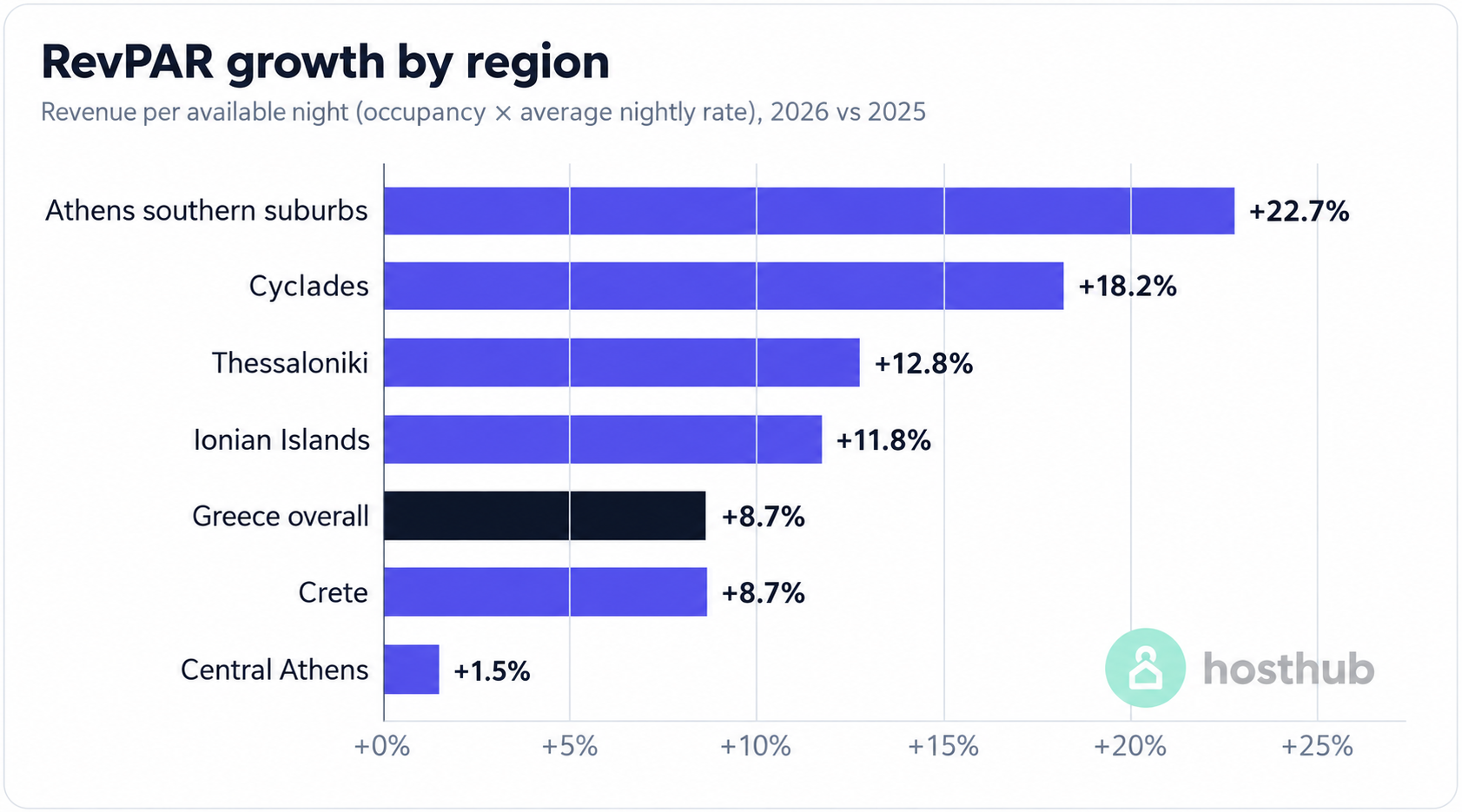
Higher rates translate into stronger revenue performance. Revenue per available night, or RevPAR, increases by 8.7%, from €38.96 to €42.36. By combining occupancy and average nightly rates, this metric provides a fuller picture of a property’s revenue performance.
Athens’ southern suburbs take the lead
Athens’ southern suburbs deliver the strongest growth, with all three key indicators rising sharply. Occupancy increases from 38.68% in 2025 to 43.30% in 2026, a relative gain of 12%. At the same time, the average nightly rate climbs from €98 to €107.43, up 9.6%.
The combination of more occupied nights and higher rates drives a 22.7% increase in RevPAR, from €37.91 to €46.52—the largest percentage gain among the areas covered by Hosthub’s analysis.
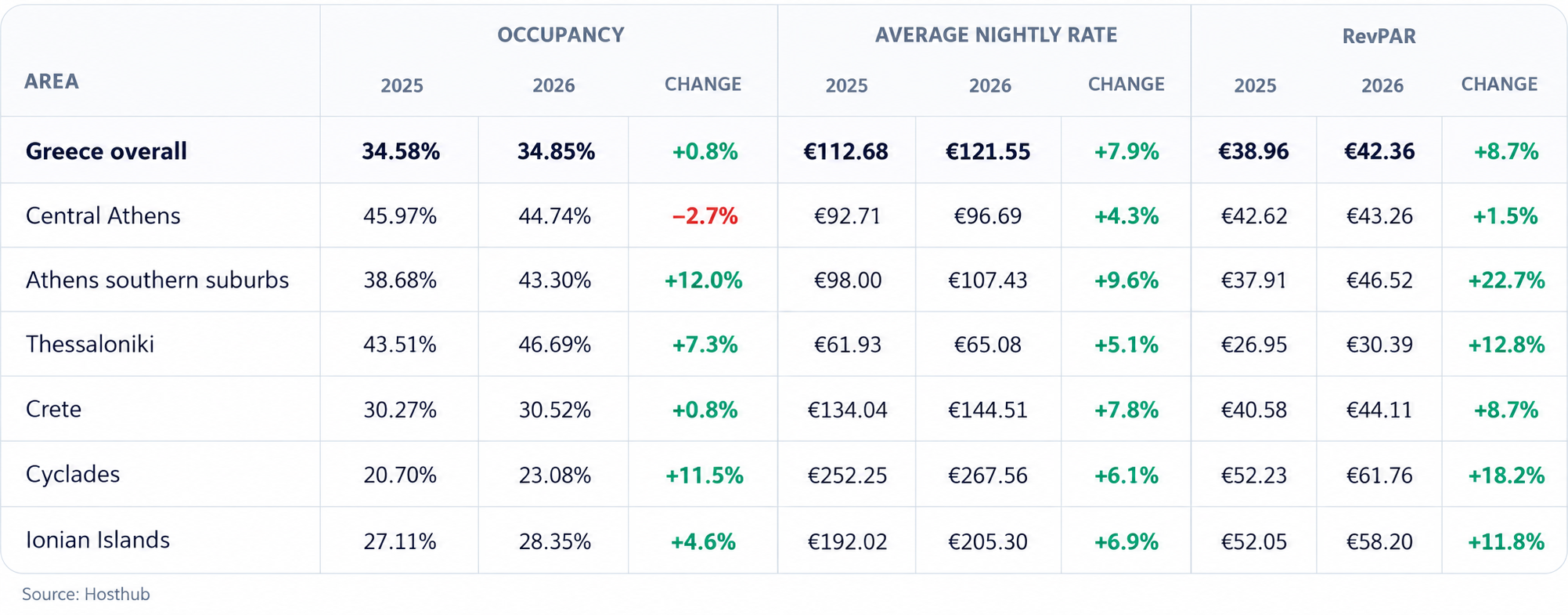
The southern suburbs also overtake central Athens in revenue per available night within a single year. In 2025, the city centre’s RevPAR stood at €42.62, comfortably ahead of the southern suburbs’ €37.91. In 2026, that relationship reverses, with the southern suburbs reaching €46.52, compared with €43.26 in the city centre.
Central Athens raises rates but loses occupancy
Central Athens presents a different picture. It is the only area in the table where occupancy declines, falling from 45.97% in 2025 to 44.74%, a relative decrease of 2.7%. Despite the drop, occupancy remains high compared with most of the markets examined.
Rates, meanwhile, continue to rise. The average nightly rate increases by 4.3%, from €92.71 to €96.69. This offsets the loss of occupancy, but only narrowly: RevPAR edges up from €42.62 to €43.26, an increase of just 1.5%, the smallest gain among the areas in the table.
The gap with the wider market is striking. Against nationwide RevPAR growth of 8.7%, central Athens’ 1.5% increase points to a much more subdued performance. Demand remains strong, but this year’s figures suggest less scope for further growth through higher occupancy than in other areas.
Thessaloniki ranks first for occupancy
In Thessaloniki, growth comes from both higher occupancy and rising rates. Occupancy increases by 7.3%, from 43.51% to 46.69%, the highest level among the markets included in the analysis.
The average nightly rate remains substantially below that of the major holiday destinations, but rises from €61.93 to €65.08, an increase of 5.1%. As a result, Thessaloniki’s RevPAR reaches €30.39, up from €26.95 last year—a gain of 12.8%.
Thessaloniki therefore follows a different growth pattern from Crete or central Athens. Its improvement does not rely solely on higher prices: occupancy also rises substantially.
Nearly €268 a night in the Cyclades
At the opposite end of the pricing spectrum from Thessaloniki are the Cyclades. The average nightly rate reaches €267.56 in 2026, up from €252.25 last year, an increase of 6.1%. This is by far the highest rate among the areas examined.
To put the difference into perspective, the average night in the Cyclades costs more than twice the national average of €121.55 and roughly four times the average in Thessaloniki.
Occupancy also improves significantly, rising from 20.70% to 23.08%, a relative increase of 11.5%.
Together, these gains lift RevPAR from €52.23 to €61.76, an increase of 18.2%. The Cyclades record the highest revenue per available night among the areas in the table, despite having the lowest occupancy.
More than €200 a night in the Ionian Islands
The Ionian Islands are the second most expensive market in the table. The average nightly rate rises by 6.9% to €205.30, compared with €192.02 in 2025.
Occupancy also improves, increasing from 27.11% to 28.35%, a relative gain of 4.6%. As a result, RevPAR rises by 11.8%, from €52.05 to €58.20.
Crete: Flat occupancy, higher rates
Crete’s performance closely mirrors the national trend. Occupancy barely changes, rising from 30.27% to 30.52%, a relative increase of just 0.8%.
The difference comes from pricing. The average nightly rate rises by 7.8%, from €134.04 to €144.51. With little change in occupancy, RevPAR increases from €40.58 to €44.11, up 8.7%—matching the nationwide growth rate.
Crete illustrates the defining trend of this year’s market: revenue can grow without a substantial increase in occupied nights, provided demand can support higher average rates.
