



A new investment category is beginning to gain a place in the portfolios of major players in the Greek real estate market. Serviced apartments, which until a few years ago were primarily the domain of specialized operators and smaller investors, are now attracting the attention of listed groups, REICs and developers, who see the model as another way to combine real estate with the dynamics of hospitality.
The recent moves by Ellaktor and Orilina Properties, combined with investments already made by developers such as DKG Development and Blend Development, are outlining a market that is beginning to gain greater depth. A common denominator is the search for properties in central urban locations, mainly in Athens and Piraeus, that can generate recurring cash flows without following exclusively the traditional residential or hotel model.
The change is particularly interesting for the real estate market, as serviced apartments sit precisely at the point where two different uses meet. On the one hand, they offer the independence of a fully equipped apartment, while on the other they provide organized hospitality services. They can therefore appeal not only to tourists visiting Athens for a few days, but also to corporate executives, professionals, digital nomads or visitors looking for accommodation for a longer period.
For the property owner, however, the key lies elsewhere: in the ability to work through long-term contracts with specialized operators and generate predictable income streams. This is also one of the reasons why the market is beginning to attract more institutional real estate capital.
The new market opened by Ellaktor
A characteristic example of this shift is Ellaktor, which, following the business transformation of recent years, is opening a new chapter in real estate and hospitality.
In the first half of 2026, the group already has a portfolio of 10 operating properties in central Athens, eight of which operate as luxury serviced apartments and are managed by its 100%-owned subsidiary Hestia. This therefore represents a more organized presence in the sector rather than simply a one-off investment. The activity falls under the new Development & Property Management and Hospitality pillar, with the group reporting that its expanded hospitality portfolio is already contributing positively to operating income and cash flows.
The The Fiction Athens, which has been operating since March 2026 under a long-term lease, is part of the same strategy, further expanding Ellaktor’s exposure to hospitality.
The move takes on greater significance when viewed alongside the company’s broader return to the real estate market. In January 2026, Landmark Holdings was established with paid-in share capital of €46 million, while in early March the new company acquired from Prodea, for €44 million, a fully leased standalone office building of 8,546.88 sq m at 15 Vasilissis Sofias Avenue.
Orilina’s €6.93 million deal
Orilina Properties is now also making a more clearly defined entry into the same space. The REIC completed the acquisition of 100% of Geraniou Anaptyxiaki Akiniton from Blend 5 Ventures Limited for a total consideration of €6.93 million, acquiring through the company the property at 30 Geraniou Street in central Athens. The completion of the transaction was announced on September 22, 2026.
This is a different real estate play from a development starting from scratch. Orilina is acquiring a ready income-producing property, with LEED Silver certification, comprising 30 fully furnished apartments and a ground-floor commercial space. The apartments are subject to a long-term lease with Limehome Greece, giving the REIC contracted rental income while also providing exposure to the growing serviced-apartment market.
The investment has an interesting history. As early as February 2026, Orilina had submitted a binding offer of €7 million to acquire the company that owns the property. In its financial statements, it explained that the asset would strengthen its income-producing property portfolio, give it a presence in a central area of Athens where significant upgrading of the building stock is underway, and increase its annual operating income. The transaction ultimately closed at €6.93 million, adjusted for the receivables and liabilities of the acquired company.
And Geraniou may not be Orilina’s only move in this direction. The company is also considering the development of its landmark property in Piraeus, known as the “Clock”, for which a conversion study into furnished residences is currently underway. The options being considered include short-term and long-term leasing, as well as operation in the form of serviced apartments, although no final decision has yet been made.
Blend: From development to the sale of mature assets
Blend Development is also gaining a particular position in the market, as it appears both as a developer of new projects and as a player capable of developing, maturing and subsequently transferring an income-producing property to an institutional investor.
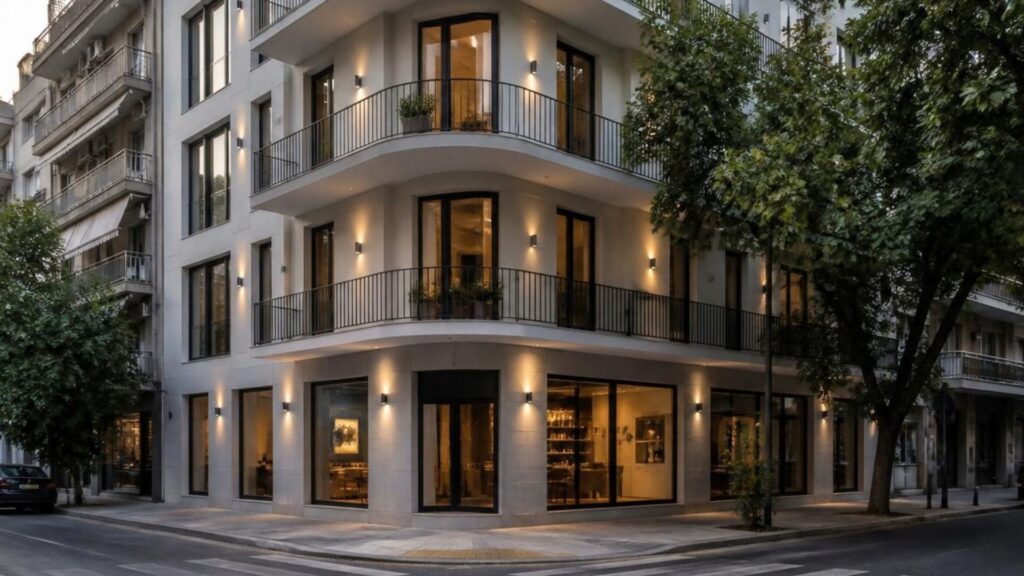
The Geraniou property is a characteristic example. Blend undertook the development and redevelopment of the building at Piraeus and Geraniou 30 and handed it over to Limehome for operation. A few months later, the special-purpose company that owned the asset was transferred to Orilina.
This essentially represents a full investment cycle: identifying the property, developing and upgrading it, securing an operator and then exiting through a sale to an institutional owner. The transaction is particularly significant for the Greek market, as it shows that serviced apartments can now also function as investment products available for transactions, provided they have mature operations and contracted cash flows.
At the same time, Blend is moving forward with another major project in central Athens, at the junction of 54 Stadiou Street and Benaki Street. The nine-storey building is being converted into a 129-room property, with Bob W as operator. The development is nearing completion, while it will also include a ground-floor restaurant and rooftop.
In Blend’s case, the interest therefore extends beyond a specific type of accommodation. Its strategy is based more on the adaptive reuse of older buildings in central locations and their conversion into modern hospitality assets capable of attracting international operators.
DKG’s €25 million-plus bet in Piraeus
DKG Development is following a different model, investing in larger-scale developments and having already brought the serviced-apartment concept to Piraeus.
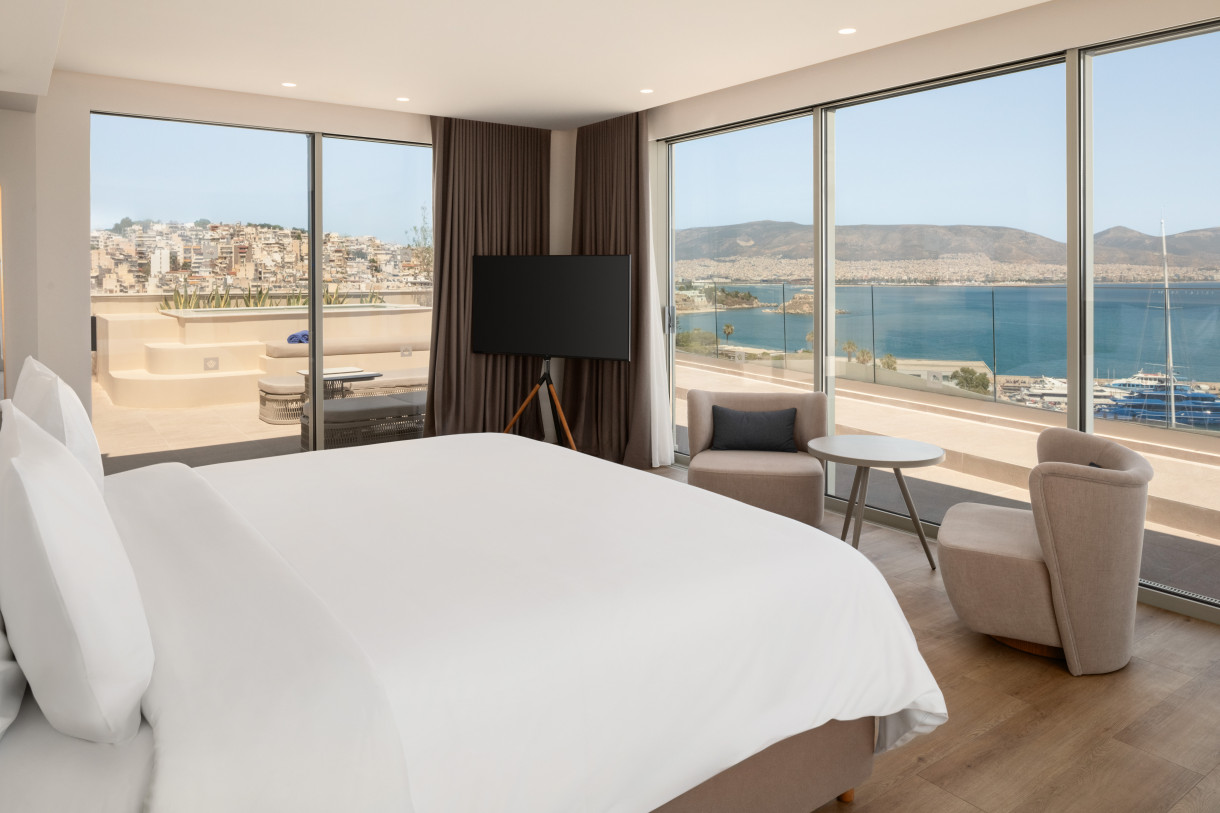
The Wyndham Residences Piraeus Marina Zeas, which opened in September, represents an investment of more than €25 million and was developed in partnership between DKG and Wyndham Hotels & Resorts. The complex covers approximately 4,300 sq m, across two adjacent eight-storey buildings, and features 72 serviced apartments, as well as a restaurant, gym, spa and event space.
DKG did not choose Zeas Marina at random. Piraeus attracts a different mix of demand from central Athens: shipping companies and executives, tourism and ferry traffic, cruise passengers, as well as visitors using the city as a stopover before or after the Greek islands.
The investment structure of the project is also of interest. At least some of the branded residences are being offered as investment properties with a 10-year lease, which according to DKG creates predictable cash flows, while investors are also expected to participate in the property’s operating performance through EBITDA.
This model goes one step beyond the traditional serviced apartment, combining property development, an international hospitality brand, operation as an accommodation property and the investment sale of individual residences.
