


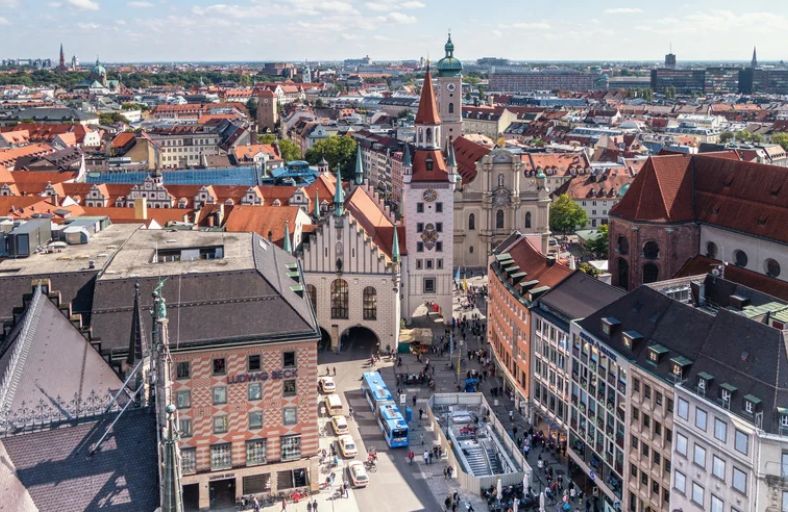

The soaring cost of housing is becoming one of Europe’s most significant social and economic challenges, triggering protests and demonstrations across several countries. From Italy and France to Germany, Spain, Portugal and Greece, the difficulty of finding affordable housing has become a major source of frustration, particularly among younger generations.
Against this backdrop, Nobel Prize-winning economist Paul Krugman supports introducing temporary caps on rent increases, arguing that they could provide immediate protection for tenants and help curb speculation in the property market.
In an interview with Euronews, the American economist acknowledges that the fundamental solution to the housing crisis is to build more homes and remove zoning and other restrictions that hinder construction. However, he points out that increasing housing supply cannot resolve the crisis immediately, as completing new housing developments takes three to five years in several European countries.
For this reason, he believes interim measures are needed to protect households until policies aimed at increasing housing supply begin to deliver results.
The model of temporary rent controls
Krugman argues that modern rent stabilization models can work without discouraging new investment in housing construction. As he explains, this does not necessarily mean a blanket, permanent ban on rent increases, but rather a system of rules that limits excessive increases while offering incentives to developers.
He cites New York as an example, where annual rent increases are regulated alongside substantial tax breaks for private developers. In exchange for these tax exemptions, investors are required to make a significant proportion of new housing units available under rent regulation.
Similarly, in Berlin, the existing framework stipulates that rents for new leases cannot exceed the local reference rent by more than 10%, with certain exemptions for newer properties.
Krugman acknowledges that such interventions are not a definitive solution to the housing crisis. Nevertheless, he believes they could be implemented for a limited period, potentially a few years, providing rapid relief to tenants.
Young people are paying the highest price
The pressure is particularly intense for young people and students, who are finding it increasingly difficult to cover housing costs in major European cities.
One striking example comes from Rome, where, according to the testimony of a 21-year-old student reported by AFP, the rent for a single room has reached €1,200.
The European Students’ Union has warned that speculative practices in the housing market are preventing thousands of young people from accessing higher education. Meanwhile, according to the European University Association, students who do not live with their parents spend almost 40% of their monthly income on housing.
According to the European Commission and the European Parliament, the financialization of housing also plays a significant role in rising prices. This refers to the growing presence of investment funds in the property market, treating homes primarily as assets expected to generate high returns.
France could trigger a new crisis in the eurozone
Beyond housing, Paul Krugman expresses serious concern about the state of France’s public finances, with the country’s public debt reaching approximately 119% of GDP.
The economist warns that a potential French debt crisis could have devastating consequences for Europe as a whole, given that France is the European Union’s second-largest economy and one of the eurozone’s main pillars.
Comparing the situation with the crisis experienced by Portugal between 2010 and 2012, he points out that the consequences of a similar development in France would be far greater. As he puts it, the country has moved from being considered “too big to fail” to being “too big to bail out.”
In his view, an economy accounting for approximately 20% of eurozone GDP cannot be handled through the same bailout mechanisms used for smaller countries.
Krugman believes France needs a credible path towards fiscal consolidation, without necessarily resorting to immediate and severe austerity measures.
The risk of deindustrialization and the need to protect European production
Another issue troubling the American economist is the competitiveness of European industry, which is facing pressure from both US tariffs and the growing presence of Chinese products in the European market.
Krugman believes Europe risks losing a significant part of its industrial production base if it fails to adapt to the new international conditions in time. He makes particular reference to the automotive industry, arguing that it could regain its competitiveness, but there is a risk that much of the industrial ecosystem supporting it will already have disappeared by the time the adjustment is complete.
Although he has long supported free trade, he believes that current geopolitical and economic conditions call for a more defensive European strategy.
His position is that Europe may need temporary protectionist measures to safeguard its production base and buy time to reorganize its industry.
Krugman’s central message is that Europe must simultaneously address the housing crisis, fiscal weaknesses and declining industrial competitiveness. As his comments suggest, long-term reforms alone are not enough when social and economic pressures demand immediate responses.
