
From October 1, 2025, new operating standards for short-term rental properties (Airbnb, Booking, Vrbo, etc.) will come into effect, marking a significant shift in the regulatory framework of the market. Property owners and managers will need to adapt to a stricter regime that combines technical specifications, insurance requirements, and on-site inspections, with heavy fines for non-compliance.
What the new law stipulates
According to Law 5170/2025, all properties rented on a short-term basis must cumulatively meet a series of requirements:
They must be primary-use spaces with natural lighting, ventilation, and air conditioning.
They must carry liability insurance covering damages or accidents.
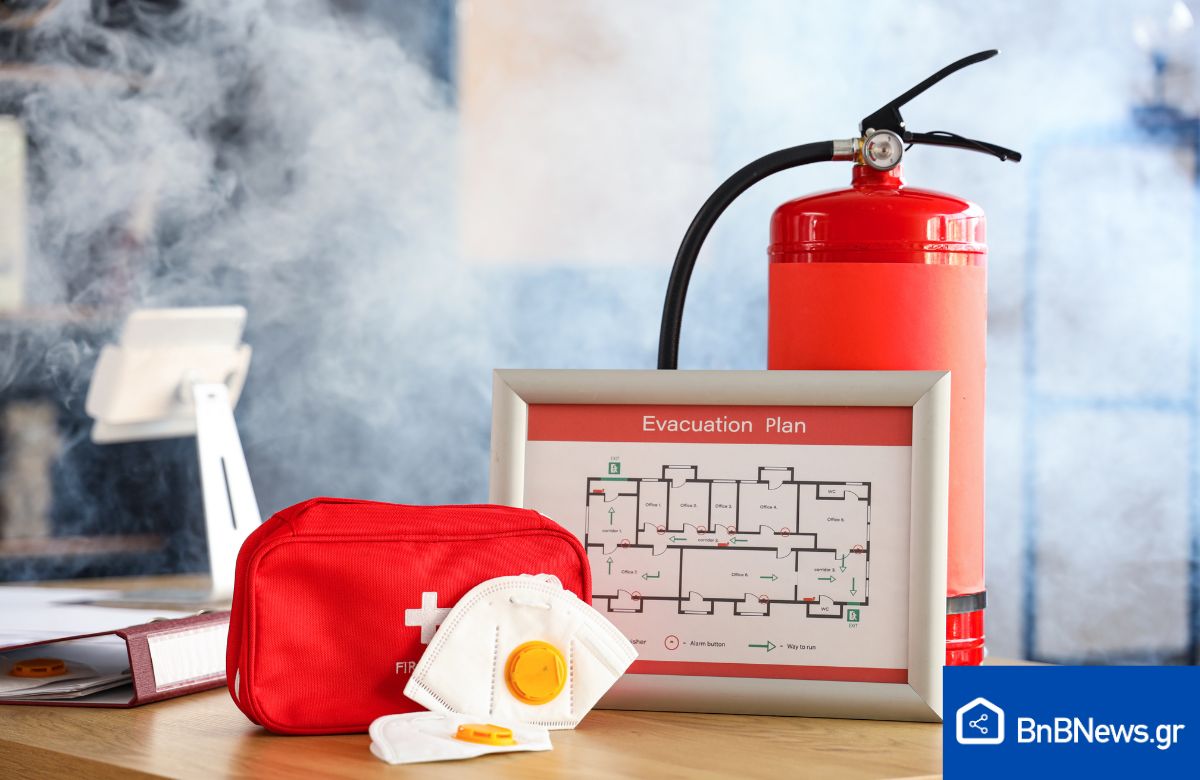
They must have a certified electrician’s declaration, fire extinguishers, smoke detectors, residual current devices, and emergency exit signage.
They must hold a valid pest control/disinfestation certificate and be equipped with a first aid kit along with an emergency contact guide.
The obligation for a first aid kit comes with specific instructions: gauze, bandages, antiseptics, thermometer, thermal blanket, and other materials—but no medicines, in order to avoid liability issues.
Inspections and fines for property managers
On-site inspections will be carried out by teams from the Ministry of Tourism and the Independent Authority for Public Revenue (AADE), with at least 10 days’ notice. Inspectors will request all necessary certificates and have the authority to verify whether requirements are met in practice.
Non-compliance entails a €5,000 administrative fine, which doubles in case of repeat violations and may rise to four times the original amount. Additional fines will be imposed if the manager refuses entry to inspectors.
First reactions
The email received by thousands of property owners from the Ministry of Tourism and AADE has generated a sense of pressure and uncertainty. Discussions in Facebook groups have been intense:
Owners question whether the law applies to traditional houses without air-conditioning but with natural climate control.
Others ask who bears responsibility for compliance when a property is subleased to a management company.
A common theme is the lack of clarifying circulars, leaving “grey areas” in many aspects.
In fact, as revealed in related posts, the first inspection appointments have already been scheduled on Cycladic islands for the very first day of implementation.
Owners’ dilemma: Keep or delete the AMA?
The new rules present owners with two main choices:
Keeping the AMA – with all obligations, even if the property is rented long-term (e.g., for the winter).
Deleting the AMA – which means exiting short-term rentals altogether, since without an AMA the property cannot remain listed on platforms.
Remaining in the registry entails continuous exposure to inspections and the obligation to comply fully with the requirements.
The bottom line: Professionalism and clarity
The government presents the new framework as a step toward upgrading the quality and safety of short-term rental properties. However, the market is calling for clear guidance and practical clarifications. From how “mandatory air-conditioning” is defined, to who is responsible in cases of subleasing, the lack of answers is fueling uncertainty among thousands of owners.
The coming months will determine whether these new regulations will serve as a turning point for the sector—or become yet another headache for small and mid-sized players in the market.
📌 Checklist: What every property owner/manager must do before October 1
Primary-use designation
Make sure the property is officially classified as a primary-use space (not storage, auxiliary space, etc.).
Liability insurance
Take out an insurance policy covering damages and accidents.
Electrical safety
Obtain a certified electrician’s declaration.
Install a residual current device (RCD) / circuit breaker.
Fire safety measures
Functional fire extinguishers in visible locations.
Smoke detectors in all rooms.
Emergency exit signage.
Hygiene & pest control
Valid pest control and disinfestation certificate.
First aid kit
Equipped with essential supplies for minor injuries, burns, and accidents. Indicatively: sterile gauze, bandages of various sizes, pressure bandages/compresses, adhesive plasters, triangular bandages, disposable gloves, antiseptic wipes or solution, saline solution in ampoules, rounded-edge scissors and tweezers, electronic thermometer, thermal blanket, single-use cold pack, and simple first-aid instructions.
No medicines—only first-aid materials.
Emergency contact guide
A visible board listing: 112, 100, 166, 199, nearest hospital/pharmacy, plus owner/manager contact details.
Air conditioning
Install air conditioning where required, or provide clarification for natural/passive cooling (guidelines pending).