




Short-term rentals in Greece recorded strong growth in nightly rates and revenue per available night in September 2026, significantly outperforming the European average. Athens also stood out, with performance improving even compared with the summer months. The figures highlight the strength of Greece’s tourism offering and the spread of demand beyond the traditional peak season, with the Greek capital ranking among Europe’s best-performing destinations in the post-summer period.
According to AirDNA’s latest figures for the European short-term rental market, Greece’s average daily rate (ADR) increased by 13.9% year on year in September, reaching €164.70. This was well above the European increase of 8.9%, which brought the continent’s average daily rate to €141.02.
The performance was even more striking for revenue per available night (RevPAR), which rose by 16.6% in Greece to €99. Across Europe, the increase was more modest at 9.1%, with revenue per available night reaching €78.06.
The Greek market therefore maintained its pricing momentum into early autumn while also delivering substantially stronger growth in revenue per available night than the European market overall.
Higher rates despite falling supply and demand
The improvement in financial performance is particularly significant because it occurred against a backdrop of declining supply and demand. Available short-term rental listings in Greece fell by 3% year on year, while booked nights declined by 2.7%.
Despite this decrease, occupancy edged up to 60.2%, above the 55.4% recorded across the European market.
The figures suggest that the Greek market retains considerable pricing power, even as the number of available properties and total booked nights decline. Meanwhile, the rise in RevPAR shows that higher rates, combined with a marginal improvement in occupancy, translated into stronger revenue per available night.
Across Europe, the direction of travel was similar, although the increases were considerably smaller. Average daily rates rose by 8.9%, while occupancy remained essentially unchanged at 55.4%. Revenue per available night increased by 9.1%, as booked nights fell by 1.2% to 46.4 million.
Overall, Europe’s short-term rental market generated higher revenue per available night despite fewer booked nights, with Greece standing out for its stronger growth in the main financial indicators.
Athens gains momentum after summer
Athens’ performance is particularly noteworthy. The city ranked among the ten strongest European urban destinations for the post-summer period, in an analysis covering 93 markets with at least 5,000 listings.
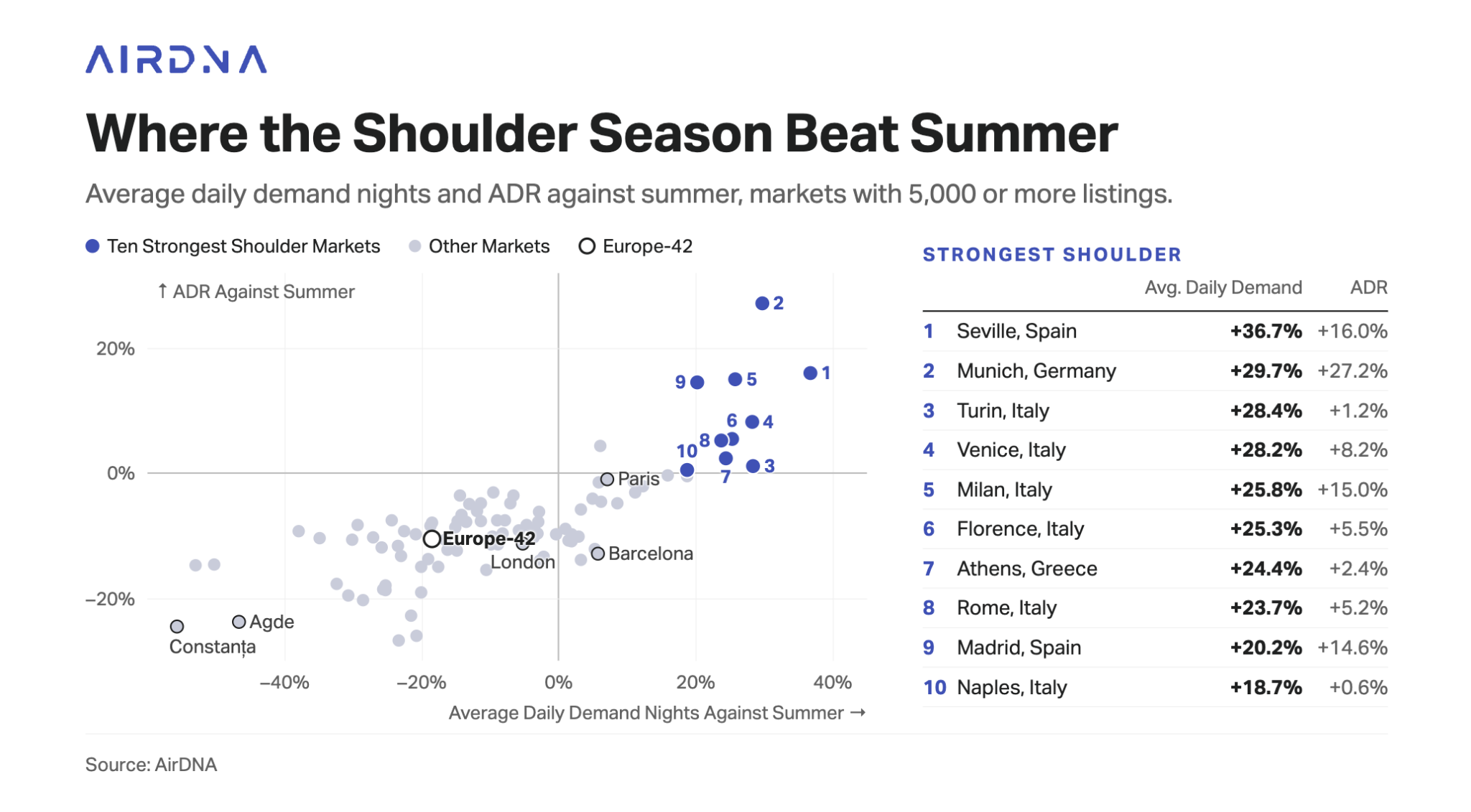
AirDNA’s analysis compares September with the June-to-August period, examining average daily demand and nightly rates. Its central finding is that, while the European market as a whole slowed after summer, some cities managed to attract more visitors while also raising their rates.
Across the ten strongest destinations, average daily demand in September was 24.6% above the summer average, while average daily rates were 8.7% higher than during June to August.
These results underline the growing importance of the post-summer period as a source of growth for European cities, with Athens among the destinations that stood out. The Greek capital is strengthening its position in a market where tourism activity is becoming less dependent on the peak summer months.
Seville, Munich and Turin topped the ranking, illustrating the momentum behind European city breaks. In Seville, average daily demand was 36.7% higher than in summer, while rates rose by 16%. In Munich, the respective increases reached 29.7% and 27.2%.
Compared with September 2025, the ten strongest destinations recorded a 12.4% increase in average daily rates to €162.03. Their occupancy reached 77.7%, compared with 55.4% for Europe overall.
Autumn’s growing appeal
September’s stronger performance highlights the importance of extending the tourism season for short-term rentals. High summer temperatures in several European cities appear to have helped shift some travel into September, when conditions are more comfortable for urban breaks.
This trend creates opportunities for destinations that can attract visitors beyond the traditional summer season. It is particularly relevant to Athens, given its rich cultural and historical heritage and its appeal as a year-round leisure destination.
However, strong revenue performance does not automatically imply a corresponding increase in total visitor numbers. The decline in booked nights in Greece and Europe is a reminder that higher rates can improve revenue performance even when demand volumes are not growing.
Booking trends will be a crucial factor in the months ahead. In early October, nights already booked for that month across Europe were 1.1% above the corresponding level in 2025, while bookings for November were 3.8% lower. These figures cover the European market as a whole and do not determine how Greece, or Athens specifically, will perform.
September’s message is nevertheless clear: Greece achieved stronger growth in rates and revenue per available night than the European average, while Athens confirmed its position among the destinations able to capture demand after summer ends. In an increasingly mature and competitive market, attracting visitors outside the peak season is becoming a crucial advantage for the long-term viability and performance of the tourism sector.
