


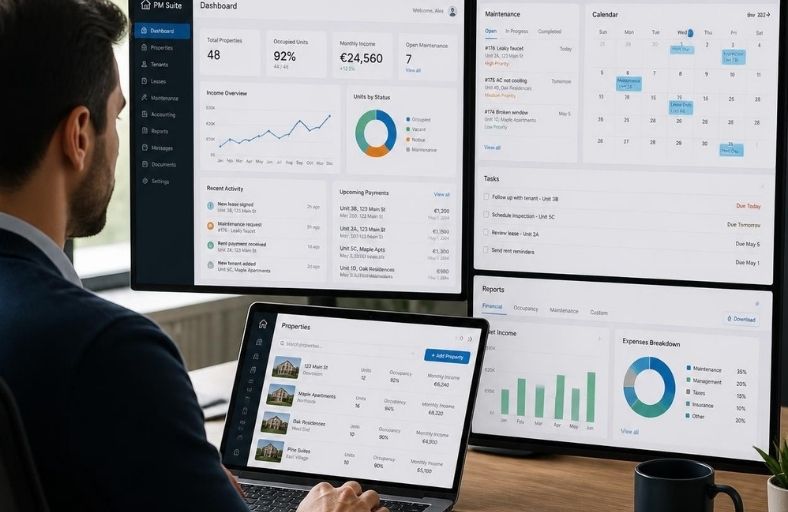

No one wakes up one morning and decides that their short-term rental business needs 13 different technology integrations. Usually, there is a specific problem that leads to the next platform: time-consuming pricing, difficulty coordinating cleanings, the need for easier check-in, or better visibility into performance.
That is how, tool by tool, the tech stack of a short-term rental business takes shape. The problem is that, as properties and operational needs increase, what started as a solution can turn into a fairly complex ecosystem of applications, data, and automations.
The scale of this complexity is captured in new research by Hostfully on the technology used by short-term rental professionals in 2026. According to its findings, the average operator uses 13 active operational integrations, in addition to the property management system itself.
For businesses managing between 51 and 100 properties, that number rises to around 18 integrations. At the same time, the businesses in the sample list their properties across an average of six to ten booking channels.
What the analysis of 31,474 integrations showed
The study was based on 31,474 active integrations from 2,248 operators using Hostfully’s PMS. To be included in the analysis, accounts had to show active platform usage and measurable growth.
The company examined technology adoption across eight key categories, including payment processing, dynamic pricing, cleaning and task management, smart locks, property protection, and guest communication and experience tools.
The results show that the core of the technology infrastructure is established from the earliest properties. Some 91% of operators use payment processing software, while dynamic pricing tools are adopted by 77% from the very first property. Depending on portfolio size, their usage ranges between 77% and 85%.
This means that price automation is no longer a tool used only by large property management companies. It has evolved into a core function even for small operators, as manual monitoring of demand, competing properties, events, and seasonality becomes increasingly difficult.
Cleaning becomes critical as the portfolio grows
The biggest change is recorded in cleaning and guest turnover management tools. Their use starts at 52% among businesses with one to five properties and reaches 88% among those managing more than 100.
The picture is expected. In a small portfolio, the owner or manager can still coordinate cleanings through phone calls, messages, and a shared calendar. However, as the number of properties, arrivals, and partners increases, the margin for error becomes smaller.
A cleaning delay or a maintenance task that was never assigned to the right person can directly affect the guest’s arrival and, ultimately, the property’s review. At this level, specialized technology is not simply a convenience, but operational infrastructure.
Smart locks, remote check-in tools, noise monitoring, and damage protection systems follow a similar path. As a business grows, it becomes increasingly difficult to rely on the physical presence of a manager at every property.
More tools do not always mean less work
Having 13 or 18 tools is not, in itself, an indication that a business is more organized. The critical question is whether they exchange data properly and whether the automations work without requiring constant human intervention.
A dynamic pricing tool, for example, delivers real value when it automatically updates the PMS and all distribution channels. Similarly, a booking should trigger, without manual data entry, the payment, arrival instructions, smart lock code, cleaning assignment, and post-checkout communication.
When these connections do not work properly, technology does not eliminate the work. It simply shifts it: from carrying out a task to checking multiple different applications, re-entering data, and correcting synchronization errors.
There is also the financial side. Every new application adds a subscription, training time, and another vendor the team needs to work with. The total cost of a tech stack is therefore not limited to monthly fees. It also includes the time required to manage it.
The goal is not the biggest, but the right tech stack
Hostfully’s research confirms how much short-term rentals have changed. The property manager no longer manages only prices, calendars, and guest messages. They are now expected to coordinate sales channels, payments, cleanings, maintenance, property access, damage protection, owner reports, and performance data.
The solution, however, is not necessarily to add another tool. For an operator, properly evaluating the tech stack starts with simpler questions: Which application actually solves a problem? Which functions overlap? Where is data still being entered twice? Which automations fail most often? And which tool is being paid for but barely used?
An effective tech stack is not the one with the most logos. It is the one where information moves from one system to another without someone having to transfer it manually. Because, ultimately, technology only has value when the property manager saves time rather than gaining another dashboard they have to remember to check.
