


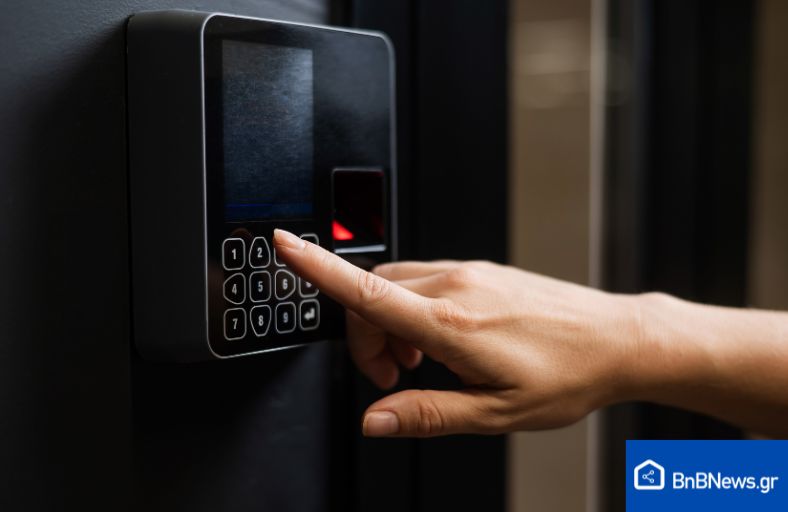

The short-term rental industry in Greece has been disrupted by Airbnb’s recent policy change, which does not allow hosts to make it mandatory for guests to use separate apps or websites – such as platforms for “smart locks” – as the only way to access the accommodation. Under the new policy, such use of third-party applications is only allowed on an optional basis and under strictly limited circumstances which takes the market back to at least the pre-COVID era.
This decision has already raised serious concerns among both accommodation operators and technology solution providers for the industry, as it is considered to undermine key elements of the operation of modern accommodation, creates legal incompatibilities with Greek and European legislation and significantly increases security risks for Hosts and guests.
Incompatibility with European and Greek legislation
The new policy appears to directly conflict with data protection and consumer rights regulations in force in Europe and Greece. According to the General Data Protection Regulation (GDPR), any processing of personal data must serve a legitimate purpose and ensure data security. Smart lock platforms use minimal data (such as name, phone number or email) solely for visitor identification purposes, offering higher security. Prohibiting their use leads administrators to less secure alternatives, potentially exposing them and the platform to GDPR violations as well as criminal and civil liability in the event of theft or injury to visitors.
At the same time, the Consumer Rights Directive 2011/83/EU provides that guests must be clearly informed of the conditions of access to the accommodation before entering into a contract. If access requires a specific method (e.g. mobile app), this information must be disclosed in advance. Airbnb’s new condition limits the ability of Hosts to fulfill this obligation although on its platform Airbnb allows Hosts to inform their guests that they provide automatic check-in.
In addition, residential buildin regulation often prohibits or restricts the installation of physical solutions, such as metal lockboxes in common areas without the unanimous consent of the co-owners. In many cases, hosts are legally unable to install such solutions, and the ban on the use of digital media leaves physical key delivery as the only alternative – with all that this entails in increasing the host’s operating costs.
Contradiction with digital reality and security
Smart access technology has now become a key industry tool, particularly after the COVID-19 pandemic, which established contactless procedures as the norm, with Airbnb then urging hosts to make the digital transition for health and safety reasons. The ability to self-check-in via electronic keys or codes is not just a convenience, but enhances the guest experience, reduces operational costs and strengthens security.
Conversely, a return to physical key exchange implies an increased burden for administrators and guests, and multiplies risks. Physical keys can easily be copied without authorisation, as demonstrated by existing cases of theft or hacking. In contrast, electronic keys are personalised, time-limited, revocable and provide a record of use, elements that dramatically increase the level of security.
Financial burden and legal risks
The practical consequences are not negligible. The loss of physical keys entails direct costs for lock replacement (150€ to 400€ per lock in Greece), while in many cases entire buildings need to be re-keyed, further increasing costs. It is reasonable to ask: who will bear these costs when they arise as a result of the new policy? Airbnb has not clarified whether it assumes any liability in this regard.
More seriously, if a crime (theft, assault, etc.) occurs after a physical key is copied, the possibility of legal liability arises for Airbnb, whose policy may have contributed to increasing the risk, despite warnings and anticipation of such incidents.
An issue that goes beyond the borders of Greece
Although the Greek legal and building framework creates more acute problems, similar regulations apply in other European countries. In Spain, Italy and France, the installation of lockboxes in public places is prohibited in many cases. Therefore, the debate is not exclusive to Greece, but touches the wider European market.
Airbnb’s new policy, while possibly seeking to simplify the guest experience or concentrate control on the platform, seems to ignore the legal, practical and technological peculiarities of the European market and especially the Greek reality. Operators and industry professionals are being asked to manage a new landscape where security, compliance and functionality are in question.
How the situation will evolve and whether Airbnb will revise or adjust its policies – remains to be seen. For now, the market is waiting for answers and solutions to issues that, it seems, are neither theoretical nor secondary.
