


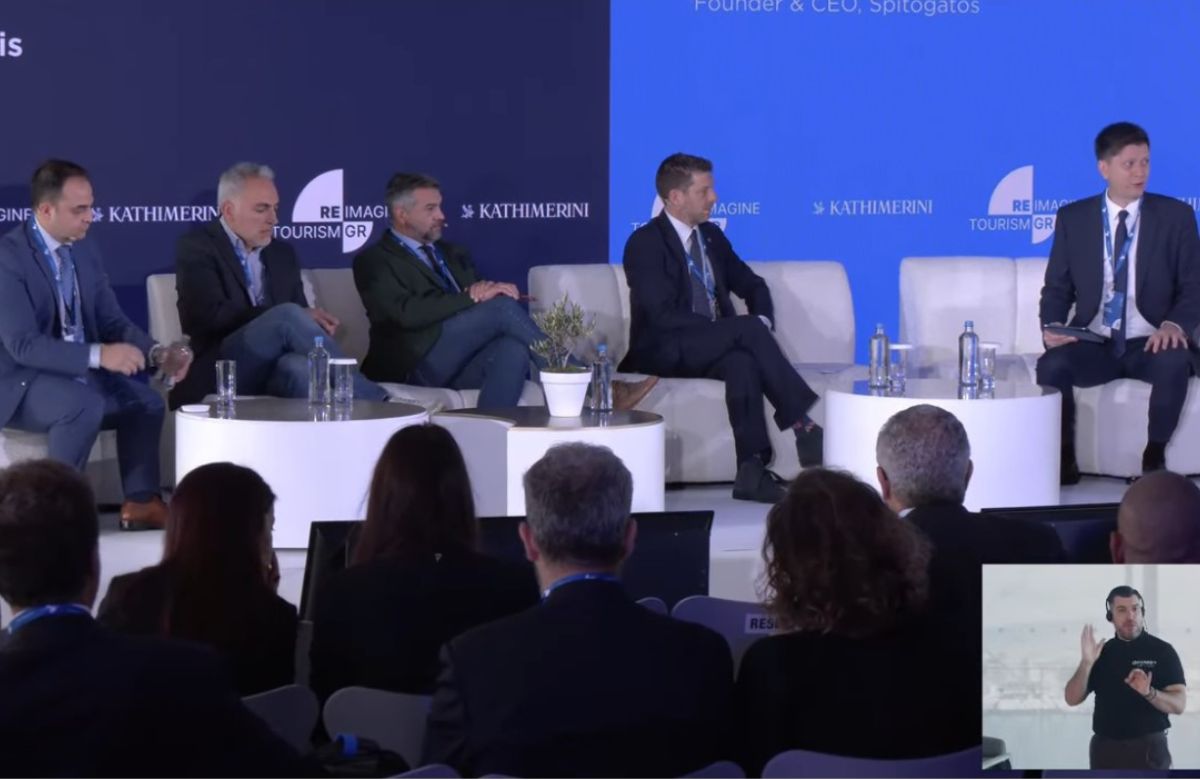

At Kathimerini’s Reimagine Tourism conference, representatives from the real-estate sector, digital platforms and development consultancies presented evidence on where short-term rentals truly have an impact—and where public narratives are misleading.
During the panel “Short-Term Rentals and Destination Resilience”, held as part of Reimagine Tourism, four key market representatives — Nasos Gavallas (STAMA Greece), Georgios Dafnos (Remaco), Dimitris Melachroinos (Spitogatos) and Matteo Sarzana (Airbnb) — attempted to answer a question that dominates public debate: do short-term rentals contribute to overtourism, high housing costs and pressure on neighbourhoods?
With clarity, documentation and differing perspectives, they demonstrated that the reality is far more complex than the prevailing narrative.
Overtourism: Yes or no? “Not even close,” says the market
Nasos Gavallas (STAMA) dismantled the idea that Athens is experiencing overtourism, stressing that discussions often compare the city to major European destinations such as Barcelona or Rome. “With the numbers we see today, we cannot speak of overtourism,” he noted.
Dimitris Melachroinos (Spitogatos) focused on real-estate demand, which has increased significantly — though not solely because of tourism.
Georgios Dafnos (Remaco) clarified that pressure points exist but are local, for example around the Acropolis, and do not indicate city-wide overtourism: “We need to examine specific geographic zones, not generalise about Athens.”
Athens’ “freeze”: A European case study
Matteo Sarzana (Airbnb) described the government’s new measures not as a “ban” but as a targeted freeze on new listings in specific central zones. According to him, the Greek approach may be “the best model in Europe” because it is data-driven, it is reviewed annually, it allows the city to adapt to demand shifts and it disperses tourism into new neighbourhoods.
“You cannot adopt a rule and expect it to last forever. Cities change,” he emphasised.
Is Airbnb causing housing prices to rise? The data says no
The panel was unequivocal: short-term rentals have an impact, but they are not the main driver of price increases.
Gavallas cited University of Athens and AUEB data showing that only 3% of housing stock in Athens is used for short-term rentals. “Three percent cannot be responsible for everything,” he said, stressing that the real issue is the “lack of affordable housing, not housing in general.”
Melachroinos added that the core problem is limited supply and high renovation costs. “Short-term rentals are the cherry on top — not the cake,” he noted. Moreover, long-term rental yields (around 5%) are not enough incentive for the renovations required.
Dafnos confirmed that Remaco’s studies do not show a direct causal link between Airbnb growth and property sale prices: effects exist but are not decisive.
European bans: when good intentions produce the opposite effect
Sarzana warned about the consequences of full prohibition models, citing Manhattan as an example where:
• hotel prices surged by up to 25%
• the underground short-term rental market expanded
• rents did not decrease
• the state lost revenue
Regarding Barcelona’s upcoming decision, he cautioned that it “will lead to exactly the same outcome.”
Bans, he argued, “criminalise people who invested in upgrading properties” and fail to eliminate a phenomenon present in every major European city.
The need for real data and policy stability
Gavallas strongly criticised the constant legislative changes: “A new law every three months — that’s irrational.” He also stressed the absence of measurable KPIs to assess the actual impact of interventions.
Melachroinos highlighted the need for renovation incentives to reduce the high percentage of vacant apartments, as well as solutions to bureaucratic hurdles that keep properties out of the market.
Dafnos reiterated that policy cannot be one-size-fits-all: “Each area is affected differently — some experience pressure, others need short-term rentals to be revitalised.”
Airbnb and cities: when the platform supports sustainability
Sarzana referred to the recent agreement with the Municipality of Athens to upgrade the Lycabettus Hill area. He described it as “a commitment to the city,” emphasising that dispersing tourist traffic is a central priority.
Closing the discussion, he reminded the audience that the Greek tourism market has characteristics that make short-term rentals essential: “Without them, the country would not have the infrastructure needed to host the additional visitors.”
