



Cyprus tourism 2026 is showing a pronounced slowdown, with tourism revenues recording a sharp 35.1% decline in April and continuing their downward trajectory for a second consecutive month, according to data from the Cyprus Statistical Service. The development highlights a period of heightened uncertainty for the country’s tourism sector, as external pressures are increasingly reflected in travel flows.
Tourism revenues fell to €197.5 million in April 2026, down from €304.2 million in April 2025, confirming that Cyprus tourism 2026 has entered a phase of pressure after a relatively stable start to the year. The decline is mainly attributed to reduced tourist arrivals, linked to geopolitical tensions and, in particular, the impact of the war in Iran and broader instability in the Middle East.
Cyprus tourism 2026: First four-month performance
Over the January–April period, Cyprus tourism 2026 recorded a total revenue decline of 23.9%, reaching €443.0 million compared with €582.5 million in the same period of 2025. This confirms that the downturn is not an isolated event in April but part of a broader negative trend that began in March.
In March, tourism revenues fell by 33.8%, while tourist arrivals dropped by 30.7%, indicating that demand for travel to Cyprus is directly affected by the international environment. In contrast, the first two months of the year showed positive momentum, with increases of 7.8% in January and 7.0% in February, before geopolitical developments began to weigh on performance.
This shift highlights the sensitivity of the Cypriot tourism model to external shocks, particularly given its reliance on organised travel flows and specific source markets.
Pressure also on per capita spending
Beyond total revenues, Cyprus tourism 2026 is also facing pressure in terms of per capita tourist spending. In April, average expenditure fell to €651.77, down 10.3% year-on-year.
According to the Cyprus Statistical Service, British tourists—the largest source market with a 39.2% share—spent an average of €86.43 per day. Polish tourists, the second-largest market with an 8.4% share, spent €81.89, while German tourists, accounting for 8%, recorded daily spending of €85.99.
The decline in spending reflects more cautious traveller behaviour, driven by global uncertainty and shifts in market composition.
 Geopolitical pressure and demand weakness
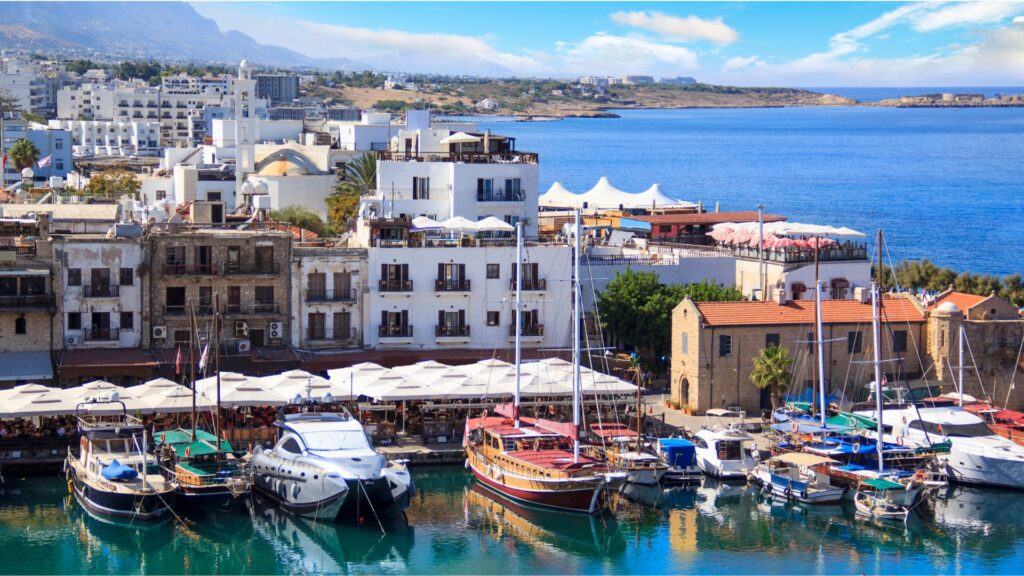 Geopolitical pressure and demand weakness
The current picture shows that Cyprus tourism 2026 is heavily influenced by external geopolitical factors rather than domestic competitiveness issues. Escalating tensions in the Middle East and their impact on aviation routes and travel sentiment have redirected flows toward perceived safer destinations.
Due to its geographic proximity to unstable regions, Cyprus is more exposed to such disruptions, which are immediately reflected in both arrivals and tourism revenues.
Outlook for the rest of 2026
Despite the weak performance in the first four months, the overall trajectory of Cyprus tourism 2026 will largely depend on geopolitical stabilization and the recovery of travel confidence in the region.
Historically, Cyprus tourism has demonstrated strong recovery capacity once external conditions normalize. However, the scale of the current downturn sets a challenging benchmark for the coming months.
In this context, Cyprus tourism 2026 will serve as a key indicator not only of the resilience of the Cypriot tourism model but also of broader tourism dynamics across the Eastern Mediterranean.
