


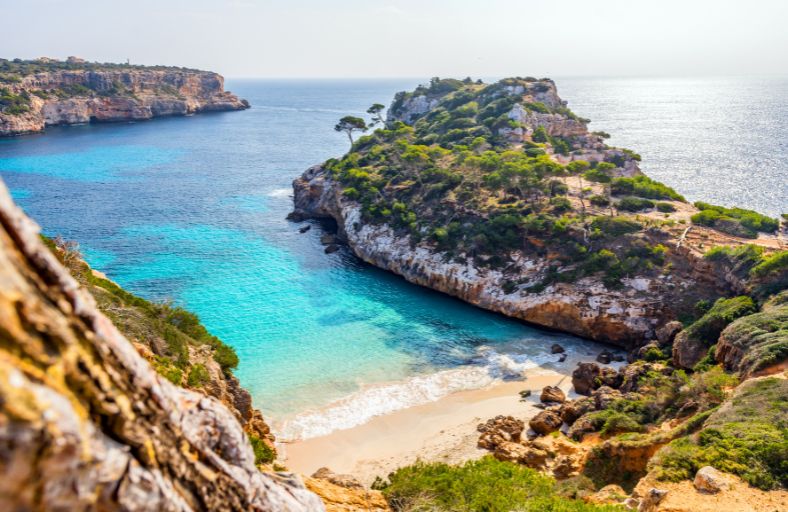

The authorities of the Balearic Islands in Spain are making a major shift in their tourism strategy, putting an end to their collaboration with social media influencers, as so-called “selfie tourism” has caused serious environmental and social impacts.
The decision, published in the Guardian, comes after years of trying to use influencers to divert tourist flow from saturated hot spots to lesser-known spots. But the result has been the opposite. Remote, fragile ecosystems were turned into scenes of daily invasion for a few minutes of photos and posts.
A typical example: The Caló des Moro
In Mallorca, Caló des Moro, a tiny beach with a capacity of just 100 people, literally collapsed under the weight of 4,000 visitors a day after being featured by a well-known influencer. Mayor María Pons urged journalists and tour operators to stop mentioning the beach, while the authorities removed all images of it from official channels.
Closure of access to Ibiza
In Es Vedrà, Ibiza, the local government closed access to the observation point as the situation had got out of hand: overcrowding, rubbish and complaints from residents threatened the viability of the area.
The price of mass tourism: Housing crisis
The phenomenon is not just about the environment. Mass tourism has driven up housing costs across Spain, with tourist apartments being the main culprit. The problem is so acute that in places like the Canary Islands, tens of thousands of protesters have taken to the streets chanting ‘Mass tourism is making us homeless’ and ‘The islands are not for sale’.
The government, backed by the Supreme Court, has already ordered Airbnb to remove 66,000 illegal tourist accommodations, as tourism development is disintegrating the social fabric of many areas.
From promotion to protection
Spain’s turnaround is not just symbolic. It marks a broader movement for sustainable tourism, where the protection of the landscape and its inhabitants takes precedence over anarchic digital promotion. The goal now is tourism decongestion, a return to the authentic character of destinations and a renegotiation of the way we ‘sell’ our beauty to the world.
Spain is not saying no to tourism, but yes to a tourism culture with respect, limits and balance. A message with global resonance, at a time when more and more destinations are suffering the same consequences.
