




In March 2026, Greece’s short-term rental market moved on a different trajectory compared with the rest of Europe, recording declines in both supply and demand, while still maintaining strong momentum in prices and revenues.
According to AirDNA data, the country’s available accommodation supply fell by 4% year-on-year, with active listings reaching 97,186, down from 101,223 in March 2025. The contraction in demand was more pronounced, declining by 8.5%, which pushed occupancy lower by 2.1 percentage points, to 52.1%.
Despite the softening in demand, the Greek market continues to demonstrate notable resilience in terms of performance. Average daily rate (ADR) increased by 7.4%, reaching €89.6, while revenue per available rental (RevPAR) rose by 3.2% to €46.6. This suggests that property managers are maintaining strong pricing power, even in a more constrained demand environment.
Why prices are rising
The increase in prices is largely linked to regulatory interventions across several European markets, including Greece. Stricter rules are limiting the entry of new, lower-priced listings that in the past exerted downward pressure on average daily rates.
In other words, new supply entering the market is of higher quality and more aligned with existing properties, while established operators retain their pricing power.
Europe: rising supply, weaker demand, but strong price growth
At European level, the picture is markedly different. March marked another month of supply expansion, with available listings rising by 4.3% year-on-year to 3.48 million.
At the same time, demand declined for the seventh consecutive month, down 3.5% to 27.9 million nights booked. This imbalance led to a 2.5% drop in average occupancy, to 52.2%.
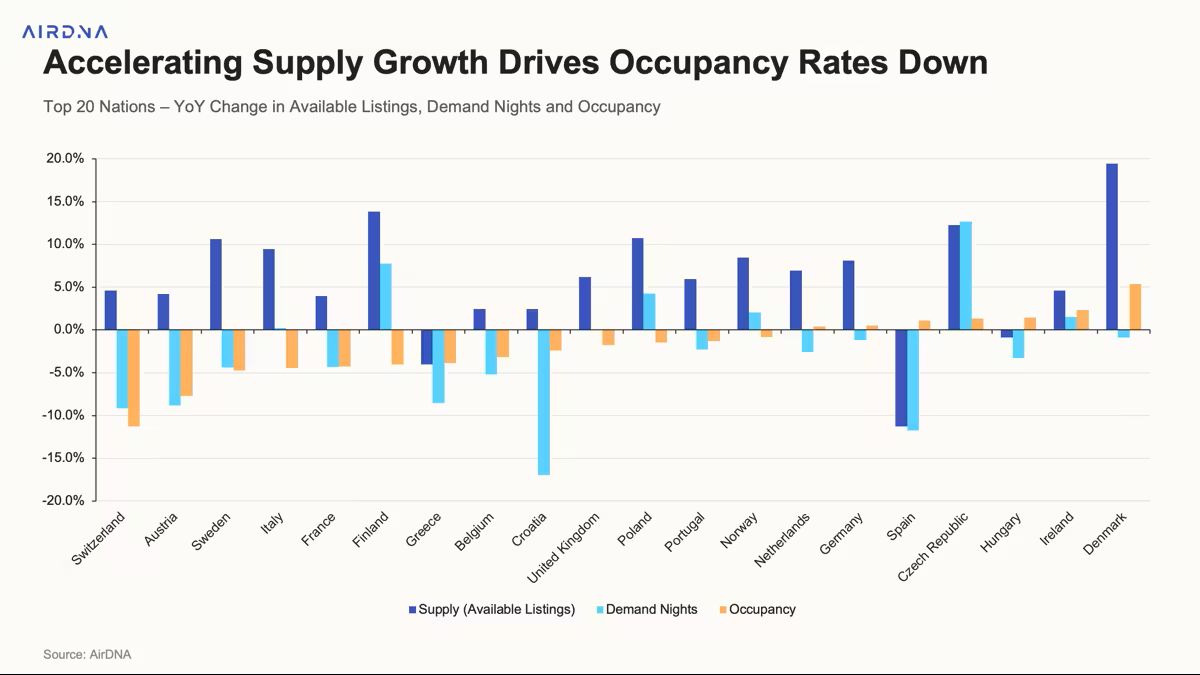
However, after a prolonged period of stagnation, prices posted a strong rebound. ADR increased by 8.2% to €123.9, driving RevPAR up by 5.6% to €64.6. This growth was primarily supported by performance in Europe’s five largest markets.
Overall, the data shows that despite oversupply and weakening demand, the market continues to deliver positive revenue growth, driven by stronger pricing.
Strong bookings for the summer season in Europe
Despite inflationary pressures and an uncertain geopolitical environment, forward bookings for the summer season in Europe are strengthening. For the June–September period, demand is up 8.7% compared with 2025.
July stands out with a 13.3% increase, followed by August (+9.5%) and September (+8.9%), confirming the growing importance of the latter as a peak holiday month.
At the same time, traveller behaviour is shifting, with average length of stay declining across all price segments. This trend suggests that travellers are opting for shorter but more frequent trips in an environment of increased uncertainty.
