



Short-term rentals in Greece are entering a phase of renewed balance, as AirDNA’s November data points to a slowdown in supply growth, a mild decline in demand, and the growing impact of regulatory interventions.
At the same time, holiday booking data suggests that Greece—and Athens in particular—is heading into the final weeks of the year with a clear competitive advantage.
Greece in November
In November 2025, the number of available short-term rental listings in Greece declined by 4.5% year over year, falling from 109,880 to 104,967 listings. This contraction is notable, as it runs counter to the European average, where supply increased by 2.5%, reaching a total of 3.45 million listings.
Demand, measured in booked nights, fell by 3.3% in Greece to 722,645 nights, a slightly milder decline than the European average (-3.7%). The key takeaway, however, is that occupancy remained unchanged at 46%, while across Europe it dropped by 2.4 percentage points to 47.5%.
This indicates that the Greek market absorbed weaker demand primarily through a reduction in supply rather than through falling occupancy—an important sign of relative resilience.
Why available listings are declining in Greece
The decline in available short-term rental listings in Greece is neither temporary nor purely seasonal. Instead, it is closely linked to a series of regulatory measures that clearly differentiate the Greek market from the European average.
Since the beginning of 2025, a ban on the registration of new short-term rental properties in central Athens has been in effect, aimed at curbing further supply growth in already saturated urban areas. In parallel, as of October 1, 2025, mandatory operational and quality standards introduced by the Ministry of Tourism came into force, covering minimum safety, equipment, and operating requirements. As a result, a significant number of properties have been unable to comply and have exited the short-term rental market altogether.
This regulatory-driven adjustment sets Greece apart from most European markets. Across Europe, available listings increased by 2.5% year over year in November, reaching 3.5 million properties, marking a modest rebound after the summer slowdown (July +0.7%, August +1.3%). Despite this recovery, supply growth remains well below the 2024 average of +18.3%, confirming a broader deceleration across the continent.
Greece, however, is moving in the opposite direction, recording a 4.5% decline in available listings in November, placing it among the few European markets experiencing a second consecutive month of supply contraction.
Spain remains the most prominent example of regulatory intervention, with available listings down 9.7% year over year, following the removal of tens of thousands of unlicensed properties. By contrast, Nordic countries continue to post strong supply growth, while Central European markets such as Belgium and Germany rank among the top performers in terms of new listings.
Greece’s trajectory therefore reflects not just Europe’s broader supply slowdown, but a deliberate shift toward a more controlled and institutionally defined short-term rental model, with direct implications for market structure. At the same time, this tighter supply environment enhances pricing power for operators, who are no longer facing an overwhelming influx of new inventory.
Revenue and pricing: A mild adjustment, not a collapse
Total revenue in Greece’s short-term rental market reached €66.1 million, down 4.8% compared with November 2024. The average daily rate (ADR) declined by just 1.5%, to €91, compared with a 3.3% drop across Europe, where ADR averaged €110. Declines were notably steeper in other markets, including Croatia (-6.0%), Switzerland (-6.3%), and France (-9.4%).
RevPAR in Greece slipped marginally by 1.1%, to €42.4, versus a 5.6% decline across Europe (€52.4). The comparison clearly shows that Greece experienced a far more moderate correction than the continental average.
The broader European picture: Stable pricing, weak demand
At the European level, November confirmed a general fatigue in demand during the second half of the year. AirDNA reports a fourth consecutive month of flat or declining demand, occupancy declines in 14 of Europe’s top 20 markets, and a sixth straight month of falling ADRs.
At the same time, the Repeat Rent Index (RRI) rose by 4% year over year for the tenth consecutive month, highlighting the continued pricing power of established hosts, in contrast to newer listings entering the market at lower price points.
Athens and the holidays: Bookings up to +32%
Where Greece truly stands out is in year-end booking pace. AirDNA data shows that for the period from December 26 to January 4, bookings are running up to 32% higher than last year.
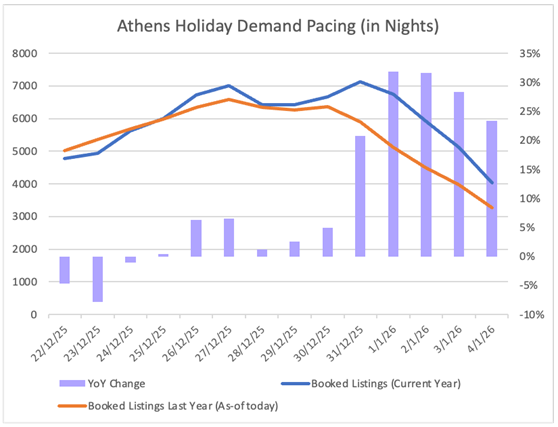
This trend is directly linked to Christmas and New Year’s Day falling on a Thursday, a calendar shift that favors extended city breaks. Across Europe, New Year’s demand is up 8.6%, but Athens is clearly outperforming.
Conclusion: A controlled adjustment with strategic upside
November 2025 confirms that Greece’s short-term rental market is in a phase of maturation and rebalancing, not crisis. Reduced supply, stable occupancy, and limited price declines suggest a market that is streamlining rather than weakening.
At the same time, strong holiday momentum and the growing role of urban tourism—led by Athens—reinforce the picture of a market moving beyond a purely seasonal model toward a more diversified and resilient structure.
In an environment of heightened uncertainty across Europe, Greece appears set to close 2025 with greater resilience, tighter control over supply, and clearer investment visibility.
For more statistics, data, and in-depth analysis on the Greek market and its outlook, don’t miss AirDNA’s presentation at the Short Stay Athens Conference, on February 19–20, 2026.
Secure your tickets early and benefit from early bird pricing.

