



The Short Stay Thessaloniki Conference 2026 took place on Saturday, November 14, as part of the international Philoxenia tourism exhibition at the TIF-HELEXPO exhibition center, presenting important insights into the performance of Greece’s short-term rental market, developments in Thessaloniki and Northern Greece, and the challenges facing industry professionals.
The first Short Stay Conference held in Northern Greece brought together representatives of international booking platforms, technology companies, property management professionals and local authorities to discuss the changing dynamics of the hospitality market.
The data presented revealed a market experiencing growing travel demand, but also significant differences between urban and holiday destinations. Discussions also focused on the impact of restrictions on new short-term rentals, tackling undeclared activity, the need for reliable data, and the transition from individual property management to organized hospitality businesses.
In his opening remarks, STAMA Greece President Vasilis Argyrakis emphasized the importance of collective representation, encouraging professionals to strengthen their participation in the association to better address industry challenges and develop partnerships.
Airbnb: Booked nights in Greece up 11.5%, demand from Turkey rises 32.7%
The continued growth in demand for short-term rentals in Greece was highlighted by Kostas Kavouras and Alberto Modaffari of Airbnb, who presented new data on the Greek market at the Short Stay Thessaloniki Conference 2026.
According to Airbnb’s figures, searches for Greece increased by 10% during January–September 2026 compared with the same period in 2025, while booked nights rose by 11.5%.
Growth was particularly strong in island destinations. Naxos and the Small Cyclades recorded a 25% increase in booked nights, followed by Zakynthos at 20%, Paros at 17%, and Crete and Rhodes at 16% each. In Northern Greece, Thessaloniki recorded a 4% increase and Halkidiki 6%.
Among international source markets, Turkey stood out with a 32.7% increase in booked nights, while the United Kingdom (+16.3%) and Germany (+14.8%) also recorded significant growth. Germany remained Airbnb’s largest source market for Greece, followed by the domestic market and the United States.
The presentation also highlighted differences in travel behavior between holiday and urban destinations.
In holiday rentals, 74% of booked nights are concentrated between June and September, compared with 44% for urban properties. Holiday rental bookings are also made an average of 74 days before arrival, compared with 42 days for urban accommodation.
Beyond: New Airbnb listings in Upper Town fall 25% following restrictions
Nikolas Zourbakis of Beyond presented the first indications of the impact of restrictions on new short-term rentals in central Thessaloniki.
According to the company’s data, 202 new Airbnb listings appeared in Upper Town between July and October 2026, compared with 269 during the same period in 2025, representing a 25% decline.
In contrast, new listings in the rest of Thessaloniki increased by 6%, from 205 to 217.
However, slower growth in short-term rental supply does not automatically mean that more homes are becoming available for permanent residents.
Beyond’s figures track Airbnb listings rather than potential transfers of properties to the long-term rental market. Furthermore, Upper Town is used as a geographical approximation of the area affected by the restrictions and does not exactly match its administrative boundaries.
Meanwhile, revenue per listing in Upper Town increased by 11% in September and 8% in October. Beyond stressed that four months of data are insufficient to draw reliable conclusions about the measure’s impact on the market.
STAMA: The need for reliable data and action against undeclared rentals
New restrictions, tax obligations and undeclared rental activity were central topics in the discussion titled “SHORT STAY 2026: New rules, restrictions and the black market.”
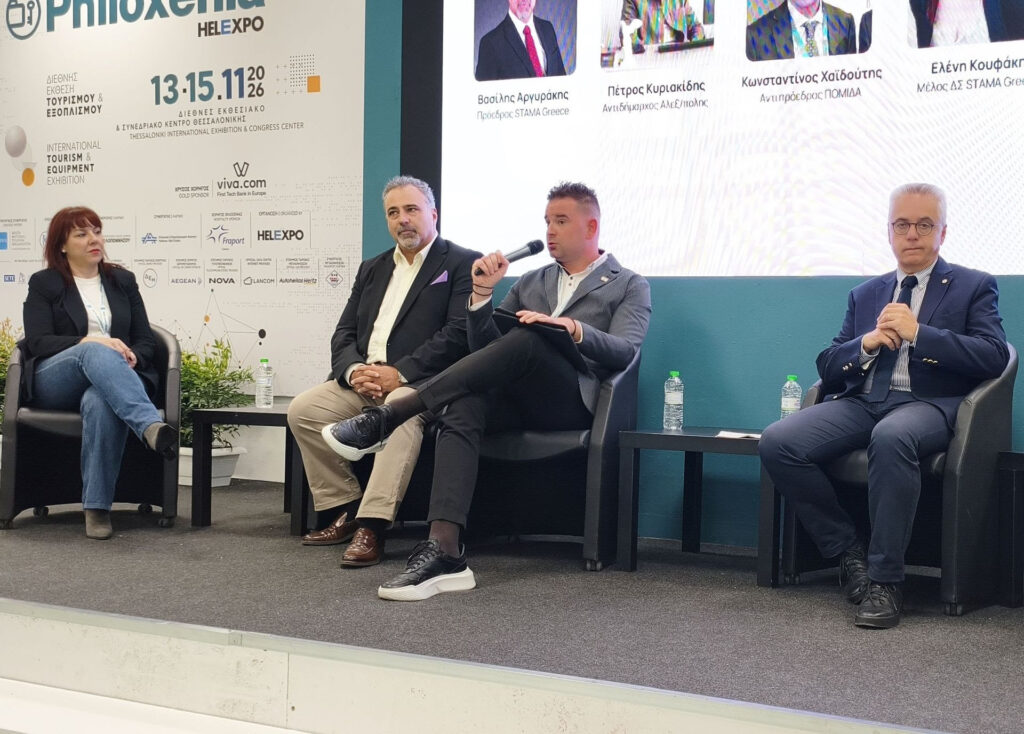
STAMA Greece President Vasilis Argyrakis expressed the association’s opposition to the prohibition on transferring a property’s Short-Term Rental Registration Number (AMA) when selling properties in areas subject to restrictions. He highlighted the consequences for owners who have invested in their properties.
He also emphasized that regulatory policies should be based on reliable and sufficient data, rather than generalized assumptions about the impact of short-term rentals on housing affordability.
Argyrakis announced that STAMA is conducting market research with the participation of its members, who collectively represent approximately 10,000 properties and 6,000 owners.
Regarding undeclared activity, he acknowledged that tax compliance has improved significantly over the past decade. However, he noted that unreported stays and transactions outside the official system still occur, stressing the need for stronger inspections and greater use of digital tools.
Konstantinos Chaidoutis, President of the Thessaloniki Property Owners Association, questioned whether restrictions could lead to meaningful reductions in rental prices, emphasizing that short-term rentals complement the wider tourism offering.
Eleni Koufaki, STAMA Greece board member and CEO of Questbnb, presented differences between the Halkidiki and Kavala markets, pointing out that demand, prices and active supply do not follow the same patterns across individual destinations.
Alexandroupolis: Short-term rentals increase from 294 to 720 properties
Particularly interesting figures for Alexandroupolis were presented by the city’s Deputy Mayor and HOMEBRAIN CEO, Petros Kyriakidis.
According to his presentation, the number of short-term rental properties increased from 294 in 2023 to 720 in 2025, reflecting the city’s development as a tourism destination.
Kyriakidis highlighted the importance of the Turkish market, which, according to his estimates, accounts for 60% to 70% of visitor traffic during certain periods, as well as the contribution of neighboring Balkan markets.
He explained that short-term rentals help accommodate growing demand for tourism stays.
The next challenge for Alexandroupolis is to diversify its source markets and extend the tourism season.
Expedia Group: Promotions are changing traveler behavior
James Cassidy, Senior Director of Vacation Rentals Partnerships at Expedia Group, discussed the changing dynamics of the international travel market.
According to Cassidy, more than half of bookings across the company’s platforms now involve some form of promotional offer, marking a significant shift in traveler behavior.
He emphasized that travelers are not simply looking for lower prices. Instead, they increasingly seek better value for money, allowing them to choose higher-quality accommodation or extend their stays.
Regarding Greece, Cassidy noted that Expedia Group recorded growth in booking value during 2026, both before the summer season and during peak months.
In Northern Greece, Thessaloniki functions as a year-round short city-break destination, while Halkidiki primarily attracts families seeking longer holidays.
On market regulation, Cassidy supported an evidence-based and proportionate approach that examines the underlying causes of housing affordability challenges.
Vrbo: 65% of travelers are exploring destinations away from the coast
Stylianos Sideris and Theofanis Timiadis of Expedia Group (Vrbo) highlighted the growing interest in inland destinations while presenting international travel trends for 2027.
According to the data they shared, 65% of travelers have taken holidays in non-coastal destinations during the past 12 months, primarily seeking experiences connected to local culture, gastronomy and art.
This trend creates opportunities for hospitality businesses and short-term rentals in lesser-known destinations, particularly in the inland areas of Northern Greece.
Booking.com: 68% of travelers plan to stay in home-style accommodation
Booking.com representatives Dimitris Masouris, Senior Account Manager, and Tasos Mitsopoulos, Account Manager, presented market trends highlighting the growing importance of alternative accommodation in travelers’ choices.
According to their presentation, 68% of travelers worldwide plan at least one stay in home-style accommodation during 2026, while 62% plan to stay in a hotel.
Home-style properties are particularly popular for family and group travel, as well as for the value for money they offer.
For Thessaloniki, the five leading source markets for bookings through Booking.com are Greece, Germany, Turkey, Cyprus and Romania. In Western and Eastern Macedonia and Thrace, Turkey ranks first, followed by Bulgaria, Greece, Romania and Germany.
The contribution of short-term rentals to local economies
The role of short-term rentals in supporting local economies and distributing tourism spending was explored during the “SHORT STAY, BIG IMPACT” panel, featuring representatives of local government and the business community.

Participants included STAMA Greece Vice President Theocharis Michailidis, Kalamaria Deputy Mayor Kostas Zacharias, Central Macedonia Deputy Regional Governor for Tourism Vicky Chatzivasileiou, and Larissa Trade Association President Charalambos Papadopoulos.
Vicky Chatzivasileiou discussed opportunities to connect accommodation with experiences throughout the wider region, including gastronomy, culture, visits to local producers and lesser-known destinations.
She suggested using digital tools, such as QR codes placed inside accommodation properties, to help visitors discover attractions, local businesses and travel routes across Central Macedonia.
Kostas Zacharias, Deputy Mayor of Kalamaria responsible for Planning, Development, Digital Governance, Youth and Tourism, emphasized cooperation between municipalities, trade associations, businesses and hospitality providers to ensure that tourism growth delivers greater benefits to local communities.
Charalambos Papadopoulos, President of the Larissa Trade Association, also participated, sharing the perspective of local retailers on how visitor spending supports economic activity in destinations.
Is an Airbnb actually profitable?
A dedicated presentation examined the real financial performance of short-term rental properties, featuring Dimitris Filippou of Sonnet Hospitality, Vasilis Iliakis of loggia, and Vasileios-Christos Oikonomou of NOMAS Property Management, with contributions from Beyond.
Using a real apartment in central Thessaloniki as a case study, the speakers highlighted the difference between gross revenue and net financial results.
The apartment generated €52,700 in annual revenue, with 61% occupancy and an average daily rate of €211.
The discussion examined taxation, platform commissions, operating expenses, and the importance of appropriate pricing strategies and distribution channel selection.
The key takeaway was that revenue alone is not enough to evaluate a short-term rental investment.
Actual profitability depends on the overall cost structure and how effectively the property is managed.
Hosthub: Can artificial intelligence run an Airbnb?
Alexandros Karavitis, co-founder and CEO of Hosthub, the Grand Sponsor of the Short Stay Thessaloniki Conference 2026, examined the possibilities and limitations of artificial intelligence in short-term rental management.
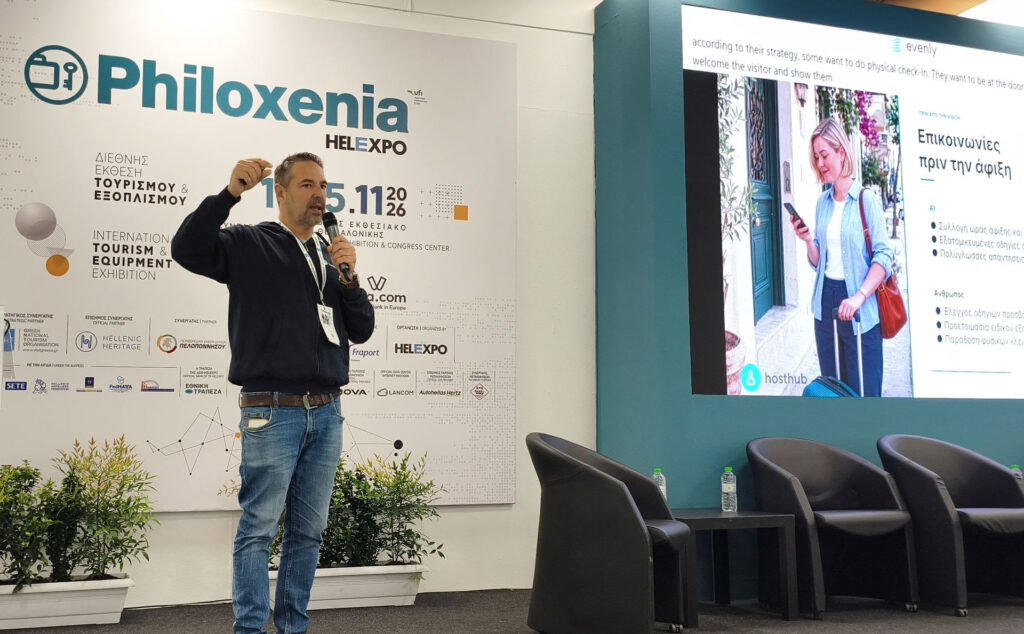
Alexandros Karavitis, co-founder and CEO of Hosthub
Through 20 specific stages of property operations, he demonstrated which tasks AI tools can already handle and where human intervention remains essential.
From market analysis, dynamic pricing and listing creation to multilingual guest communication, task coordination and tax data preparation, artificial intelligence can significantly reduce the daily administrative workload.
However, business decisions, emergency management, property inspections and personalized guest service still require human involvement and responsibility.
The presentation’s central message was captured in the phrase “Less management. More hospitality,” positioning technology as a tool that frees up time for more meaningful guest care.
From a single property to an organized hospitality business
The challenges of scaling a property management company were explored during the panel “From 1 to 100+ properties, from host to hospitality business,” moderated by Alexandros Karavitis.
Katerina Dakovic, General Manager of Travel Pro, discussed the company’s development from a tourism services business into a property management operation overseeing more than 350 properties across the wider Halkidiki region.
Dimitris Missas, co-founder and CEO of Chrysalis, highlighted the operational difficulties arising from geographically dispersed properties, seasonality and the need to combine in-house teams with external partners.
Konstantinos Atmatzidis, founder of AtmaBnB, described the company’s growth from its first property in 2016 to a portfolio of 60 accommodation units.
He identified the transition from five to fifteen properties as the most challenging stage, when personal management had to give way to structured operational processes.
The common conclusion was that business growth depends on more than the number of properties under management. It also requires effective organization, staff management, cost control and consistently high service quality.
New technology solutions for short-term rentals
The conference also showcased innovative solutions designed to improve hospitality services and make short-term rental management more efficient.
Guestin introduced its digital platform connecting accommodation providers with local cafés, enabling hosts to offer breakfast to guests without operating their own food service facilities.
RevMark presented an AI-powered platform that automates financial processes, integrates accounting and banking data, and provides real-time insights into profitability and cash flow.
AegeanBot highlighted the capabilities of an integrated property management system (PMS), combining AI-powered guest communication tools, reservation management and direct booking functionality.
Finally, Homesberg, represented by co-founder Pamir Birlik, discussed the importance of a property’s position in Airbnb search results and how pricing strategies can influence listing visibility and competitiveness.
The next chapter for short-term rentals
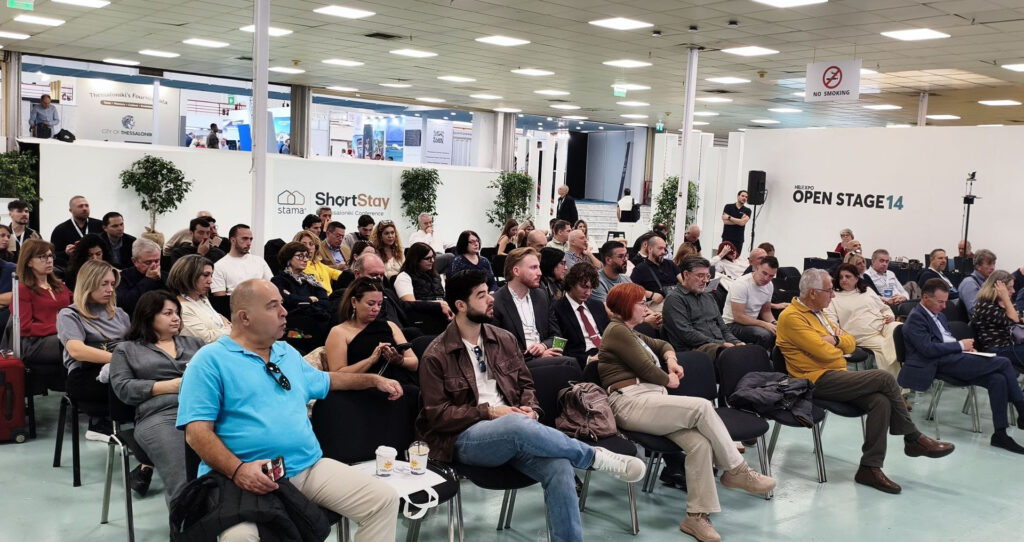
The Short Stay Thessaloniki Conference 2026 confirmed that the future of short-term rentals is closely linked to professionalism, technology adoption and the financial sustainability of hospitality businesses.
Emerging travel trends are creating opportunities for both established destinations and inland regions. At the same time, increasingly complex operations make data-driven decision-making, business organization and investment in hospitality quality more important than ever.
The discussions also highlighted the need for meaningful dialogue between government, local authorities and industry professionals, supported by reliable data and clear operating rules.
The conference concluded with the recognition that short-term rentals are now an integral part of the tourism ecosystem, offering considerable opportunities for further growth while requiring higher standards of professionalism and adaptation to changing market conditions.
