




Vrbo is entering a new phase of restructuring its commercial strategy and strengthening its position in the vacation rental market. The platform is introducing significant changes to its host fee structure while expanding opportunities for property visibility and distribution through Expedia’s network.
A key change is the introduction of a standard 12% commission for most hosts, effective October 29, 2026. The new policy replaces the previous fee structures, which included a commission of approximately 8% for hosts using the pay-per-booking model and 5% for property managers connected to the platform through property management systems.
The change is therefore more significant for professional property managers. Vrbo maintains that the new structure simplifies the booking experience for travelers and, in most cases, results in lower service fees for guests.
Expedia Group CEO Ariane Gorin addressed the change during the company’s third-quarter earnings presentation, emphasizing that the goal is to simplify the traveler experience. She also noted that the company does not expect a significant change in the overall percentage of revenue it earns from bookings.
However, the new commission does not necessarily mean that Vrbo will become more affordable for all its partners. Assessing the actual cost requires considering both the net revenue received by hosts and the final price paid by travelers, including additional fees.
Vrbo vacation rentals to join Expedia travel packages
One of the most important strategic initiatives involves integrating Vrbo properties into Expedia’s travel packages. This will allow travelers to combine flights, car rentals, and accommodation in Vrbo vacation homes within a single booking.
The initiative is expected to increase property visibility among a broader audience, attracting travelers who have traditionally used Expedia to book complete travel packages.
The service is still under development, and no specific launch date has been announced. During its initial rollout, it is expected to cover most markets, excluding Canada, the United Kingdom, and the European Union.
This means that properties listed through Vrbo’s European brands, such as Abritel in France and FeWo-direkt in Germany, are not expected to participate in the first phase.
Traveler loyalty and the One Key program
At the same time, Expedia is seeking to strengthen customer retention through its One Key loyalty program, which connects Expedia, Hotels.com, and Vrbo.
Members earn OneKeyCash rewards and gain access to higher membership tiers and additional benefits based on their booking activity. According to Expedia’s management, travelers in the program’s higher tiers are growing at a faster rate and making more frequent bookings through the company’s owned channels.
For property managers, the program creates additional opportunities to attract repeat customers. However, discounts offered to One Key members are funded by hosts themselves, unlike OneKeyCash rewards, which are covered by Expedia.
New search, payment and customer service tools
Vrbo’s technological transformation is another key pillar of its strategy. Among the new features is natural language search, which allows travelers to describe the type of accommodation and experience they are looking for in their own words, rather than relying exclusively on predefined filters.
The feature is currently available in beta on Vrbo’s English-language website and app in the United States.
In addition, Vrbo is introducing Reserve Now, Pay Later, allowing eligible travelers in the United States to make reservations without paying upfront. The full payment is collected seven days before the end of the free cancellation period.
The company is also investing in improving the arrival and stay experience by bringing essential information together in one place, including check-in and check-out times, access codes, directions, and house rules.
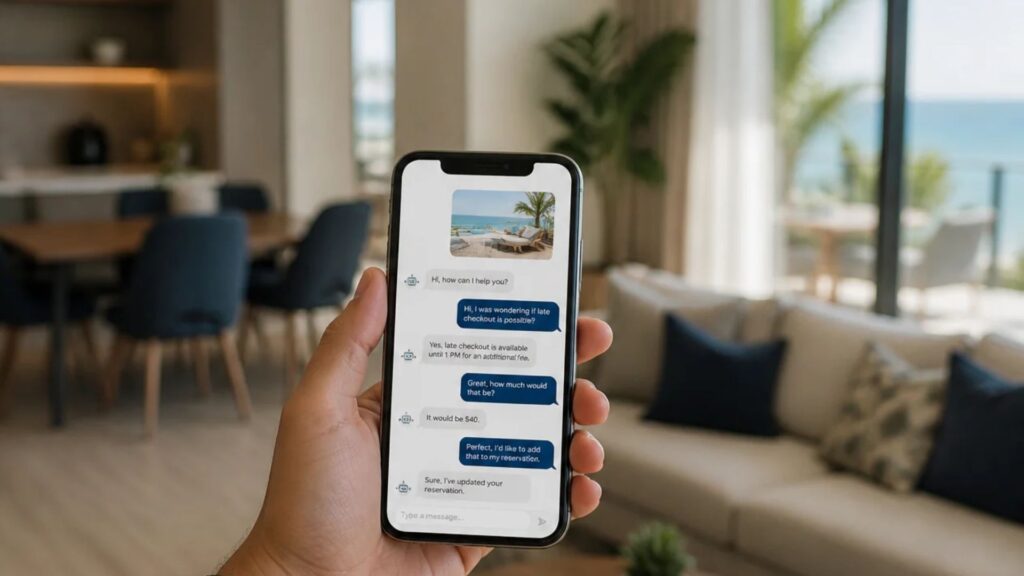
Another important development is the use of artificial intelligence in customer service. According to Ariane Gorin, Vrbo’s new AI-powered customer service assistant successfully resolved more than 15% of incoming customer inquiries during its first two months of operation.
Expedia’s consumer brands record 7% booking growth
In terms of performance, Expedia Group’s third-quarter 2026 results show that its consumer brands, including Vrbo, recorded a 7% increase in bookings compared with the same quarter in 2025.
However, this growth does not represent a separate performance indicator for Vrbo, as Expedia does not disclose standalone booking figures for the vacation rental platform.
At group level, overall growth was higher, reaching 11%, supported significantly by travel distribution partnerships with third-party businesses, including banks and airlines.
Geographically, room nights booked through Expedia Group increased at a mid-single-digit rate in the United States, while growth in Europe, the Middle East, and Africa was limited to a low-single-digit percentage. The region was the group’s weakest-performing geographic market during the third quarter.
More cautious expectations for the final quarter
For the fourth quarter of 2026, Expedia Group expects booking growth to slow to between 3% and 5%, compared with 11% in the third quarter.
Management attributes the more cautious outlook to several factors, including a weaker start to the quarter, the impact of the US election cycle, geopolitical tensions in the Middle East and Europe, and some demand shifting into the third quarter due to changes in the timing of this year’s promotional campaigns.
This slowdown does not indicate a decline in bookings, but rather a slower pace of growth compared with the particularly strong third quarter.
Vrbo’s strategy for the next phase
The changes to the commission structure, the integration of vacation rentals into Expedia travel packages, the expansion of the loyalty program, and the adoption of artificial intelligence reflect Vrbo’s efforts to strengthen its competitive position in the alternative accommodation market.
The key question for the platform is whether these new capabilities will translate into additional bookings and higher revenue for its partners, particularly at a time when demand growth is showing signs of slowing in certain markets.
For professional property managers, the new 12% commission makes it necessary to reassess pricing strategies and the profitability of each distribution channel. At the same time, the real value of the new tools will depend on whether they attract new customers rather than simply shifting existing bookings from one channel to another.
Ultimately, Vrbo is seeking to leverage Expedia’s broader ecosystem, transforming the search for a vacation home into part of a more comprehensive travel experience.
