


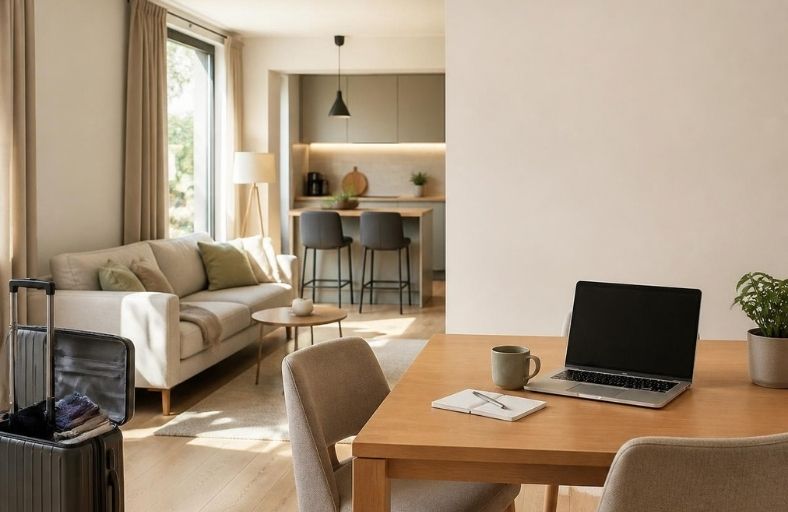

A Landing survey of 1,000 Americans records the new needs in longer stays – More space, a kitchen, laundry facilities and workspace are now high on travelers’ list
Nearly three in four travelers say they change the way they choose accommodation when their stay becomes longer, while more than half believe that none of the available options fully meets their needs at least some of the time. This picture highlights the demand for more flexible forms of hospitality, which combine the advantages of hotels and furnished homes.
In a nationwide survey of 1,000 Americans, Landing found that 85% had taken a trip of at least five nights in the past five years, while 73% said they make different accommodation choices when the stay is longer.
The length of the trip also appears to change travelers’ own requirements. Price and location remain the two most important factors, but comfort and functionality are becoming increasingly important. Some 49% rank comfort and the ability to “live” easily in the space among the key selection criteria, while 41% place particular importance on practical amenities, such as a kitchen, laundry facilities and workspace.
The longer the stay, the higher the expectations
A stay of two or three nights can still work even in a smaller accommodation unit. When the stay exceeds five nights, however, the property is expected to support more aspects of everyday life.
Some 51% of travelers believe that hotels are not ideal for longer stays. Meanwhile, 45% would like to have a kitchen, 26% a separate living area, while 22% said they felt limited or uncomfortable in the available space. At the same time, 20% faced a problem with doing laundry, due to the lack of a suitable option.
As a result, the issue is no longer only a clean and well-organized room. For a longer stay, travelers need a space that can function as a temporary home, office and place of rest.
The hotel or short-term rental dilemma
This is where the main dilemma of today’s hospitality market appears.
Hotels offer a stable level of service and predictability. However, in longer stays, they often fall short in terms of space and everyday facilities.
Short-term rentals, on the other hand, offer more space, a kitchen and a home-like feeling. Their main problem, however, is the consistency of the experience.
In the survey, 38% cited concerns about cleanliness, 32% unexpected or hidden fees and 29% inaccurate photos or descriptions. Another 24% said they were uncertain about the amenities they would find at the property, while 20% mentioned inconsistency in quality.
The gap between image and reality is particularly telling: 52% of those who have stayed in a short-term rental reported arriving at a property that was significantly different from what they had seen online. For about one in four, this has happened more than once.
Travelers compromise – and pay more
When no option fully meets their needs, travelers do not stop traveling. They adapt.
Some 21% say they often or always make compromises when choosing accommodation for longer stays, while another 37% say this happens sometimes. Only 11% say they never need to compromise.
These compromises, however, also have an economic impact. Some 41% report that when the accommodation does not meet their needs, they end up spending more money on food, alternative accommodation solutions or upgrades. Meanwhile, 32% see their comfort reduced, 23% are affected in terms of peace of mind and 20% lose time looking for solutions.

Families and business travelers at the center
The problem becomes more intense for those who need the accommodation for more than just an overnight stay.
79% of parents change the way they choose accommodation when the stay exceeds five nights. Families need more space, a kitchen and facilities that can support children’s everyday routines.
The pressure is even greater for frequent business travelers. Some 87% say they are forced to compromise at least some of the time in longer stays. At the same time, one quarter struggle to find a suitable workspace during a longer hotel stay, compared with 9% of all travelers.
The “third option” gains ground
The most interesting finding of the survey comes when travelers are asked to choose between a hotel, a short-term rental and a professionally managed, furnished apartment, with all options offered at a similar price.
Some 46% choose the furnished apartment, compared with 31% for the traditional hotel and 21% for the short-term rental. Even among those who exclusively choose hotels, 42% would choose the furnished apartment in this scenario.
The message is that travelers do not necessarily want to choose between the reliability of a hotel and the comfort of a home.
Some 60% of respondents say they would often or always choose a solution that combines hotel-level consistency and support with the space, kitchen, laundry facilities and comfort of a furnished home.
The hospitality market is looking for the “in-between”
The change in travelers’ needs does not only concern the choice of accommodation. It also changes the way bookings are made.
Some 73% of travelers make a different choice when the stay reaches five or more nights. Some 31% apply completely different criteria, while another 31% spend significantly more time researching before making a booking.
In longer stays, price still comes first, at 67%, followed by location at 55%. However, comfort and functionality reach 49%, while practical amenities, such as a kitchen, laundry facilities and workspace, reach 41%.
The trend points toward a model that sits between the hotel and the traditional short-term rental: a space that feels like home, but offers the predictability and professional management of a hotel.
For the accommodation market, this creates a new opportunity. As longer stays increase and travelers combine work, family and leisure, the value of a property that does not simply offer a bed for the night becomes greater, but can support the guest’s daily life for as long as they are away from home.
