



Rising occupancy levels, a slight correction in average daily rates, and sharp regional divergences across Greece’s leading destinations are defining the short-term rental market in 2026.
The summer season for Greece’s short-term rental sector is unfolding with clear signs of resilience, sustained demand, and increasingly mature pricing behaviour. According to an analysis by Beyond Pricing on behalf of STAMA, based on real booking data for the June–September 2026 period, the market remains firmly in positive territory despite mild pressure on average rates.
At a national level, occupancy stands at 41%, up 7.1% year-on-year. In contrast, the average daily rate (ADR) declines slightly by 4.5%, settling at €104 compared to €109 in 2025. Booking patterns continue to shift earlier in the season, with average lead time increasing to 19.8 days (+6.1%), while average length of stay remains broadly stable at 3.6 nights.
Behind these headline figures, however, the market reveals strong regional fragmentation, with each destination following a distinct trajectory.
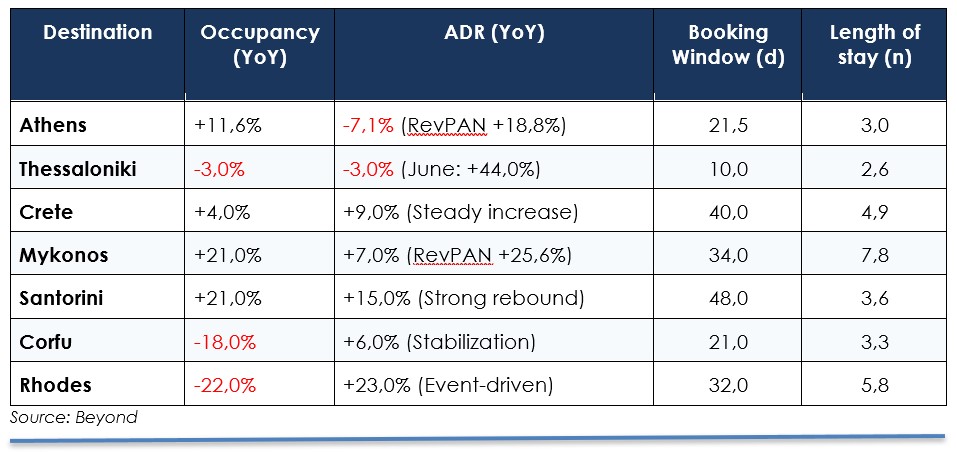
Cyclades rebound strongly – Crete remains the benchmark
The most notable shift is recorded in the Cyclades, where several destinations are staging a strong recovery after a more subdued previous year.
In Mykonos, performance has clearly improved, with summer prices rising by around 7% to a range between €250 and €480. Demand for June and July is up 21%, while Revenue per Available Night (RevPAN) increases to €177.5 from €141.3 in 2025. Average stay reaches 7.8 nights, the highest among all analysed destinations, although September shows a noticeable slowdown.
Santorini is also regaining momentum. Prices increase by approximately 15%, ranging from just under €200 to €430. RevPAN rises 24% to €114.9, still below the 2024 peak but significantly above last year’s levels. Occupancy starts the season on a stronger footing compared to 2025, while demand remains solid into September, reinforcing the trend toward a longer season.
At the same time, Crete continues to operate as the most stable and powerful pillar of the market. Occupancy remains consistently 3–5 percentage points higher year-on-year, while prices trend upward from around €315 in early summer to €480 in August. Average RevPAN reaches €248.9, the highest nationwide, confirming Crete’s dominant position in terms of performance and yield.
Ionian Islands and Dodecanese: From peaks to normalisation
A more moderate trajectory is observed in Corfu and Rhodes, both of which posted exceptionally strong results in 2025.
In Corfu, prices remain elevated at around €250–€300, but RevPAN declines to €104.2 from €127.1 last year. This adjustment is primarily driven by an 18% drop in occupancy, signalling a return to more balanced market conditions after last year’s peak.
A similar pattern emerges in Rhodes. Despite a 23% increase in average prices, RevPAN falls to €127.2 from €152 in 2025, while occupancy declines by 22% throughout the summer season. The market appears to be recalibrating after an exceptionally strong year.
Athens on the rise, Thessaloniki more subdued
Diverging trends are also evident in Greece’s two major urban centres.
Athens records strong growth in demand, with occupancy rising by 33% and prices ranging between €180 and €280 during the summer. RevPAN increases by 18.8% to €33.7, confirming the city’s consolidation as a leading short-break destination with growing international appeal.
By contrast, Thessaloniki shows a more muted performance. Occupancy declines by 3%, while prices fluctuate significantly throughout the season. Despite a peak reaching €195 in August, overall RevPAN rises only marginally by 3.7% to €25.9.
At the same time, booking behaviour continues to evolve. The most forward-planned bookings are recorded in Santorini (48 days ahead), Crete (40 days), and Mykonos (34 days), while urban markets remain last-minute driven, with 21.5 days in Athens and just 10 days in Thessaloniki.
Overall, the 2026 short-term rental season in Greece reflects a maturing yet highly dynamic market, where the Cyclades are rebounding strongly, Crete maintains its leadership position, Athens strengthens its urban tourism profile, and other regions adjust to a more balanced post-peak environment.
